

PFZ Zirconia Crown Benefits: Complete Dental Guide
A patient walks in wanting a crown that looks natural, holds up for years, and does not chip on the first bite of a hard roll. That single request explains why PFZ zirconia crown benefits have become such a common topic in restorative dentistry conversations. Porcelain fused to zirconia, commonly abbreviated as PFZ, combines a high-strength zirconia core with a layered porcelain surface, providing clinicians with a restoration that behaves like a hybrid of traditional PFM and full-contour zirconia.
This guide breaks down what a PFZ crown actually is, where it performs best, and why so many dental practices are shifting toward it for both anterior and posterior cases. Every section is written to answer the questions dentists, prosthodontists, and lab partners actually ask before selecting a restorative option.
Restorative dentistry has moved through several material generations, from full metal crowns to porcelain fused to metal, and now toward ceramic-based systems built around zirconia. Each shift happened because clinicians and patients wanted something better, whether that meant improved esthetics, stronger margins, or fewer remakes. PFZ crowns represent one of the more practical steps in that evolution, since they do not ask a dentist to abandon the layering techniques a lab already knows well.
What Is a PFZ Zirconia Crown?
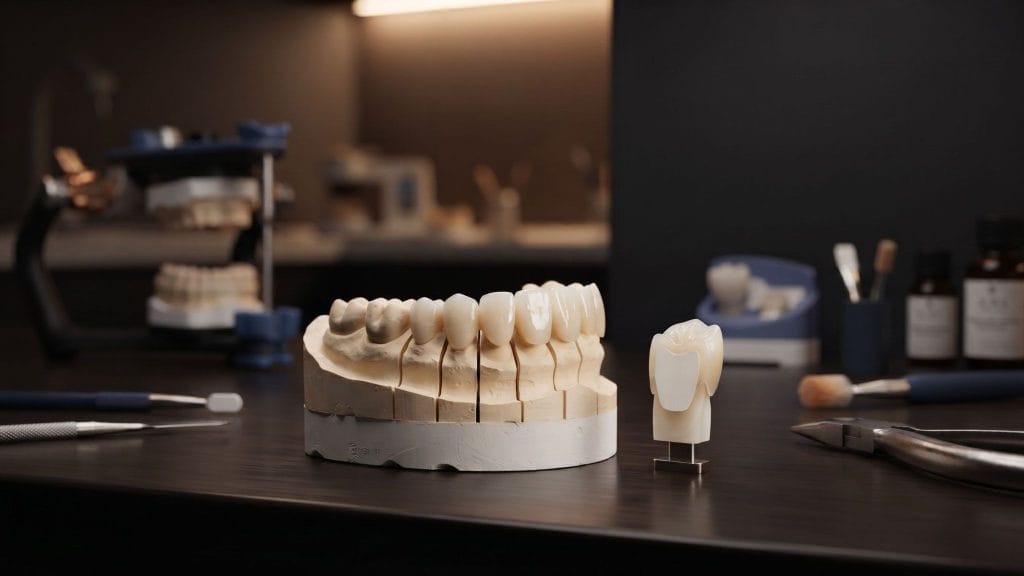
A PFZ crown, short for porcelain fused to zirconia, uses a milled zirconia coping or full-contour zirconia substructure as its base, with layered porcelain applied over the facial or entire surface for esthetics. The zirconia core replaces the metal substructure found in traditional PFM crowns, which removes the gray shadowing at the gumline and improves biocompatibility.
This design gives clinicians a restoration that carries the strength of zirconia while keeping the lifelike translucency of layered ceramic. It is one of the main reasons PFZ layered zirconia crown benefits are discussed so frequently in prosthodontic literature and continuing education courses.
What Are the Main PFZ Zirconia Crown Benefits?
The benefits of PFZ zirconia crowns come down to a practical mix of strength, appearance, and clinical flexibility. Dentists rarely choose a restoration for one reason alone, and PFZ crowns tend to check several boxes at once.
Here is a quick breakdown of what makes this restoration type stand out:
- High flexural strength from the zirconia core, typically supporting long-term use in both anterior and posterior regions.
- Natural light transmission through the layered porcelain, which mimics enamel translucency better than full metal or metal ceramic options.
- No dark metal margins, since the substructure is tooth colored rather than a metal alloy.
- Strong marginal fit achievable through digital scanning and CAD CAM milling.
- Biocompatibility, with minimal risk of metal sensitivity reactions compared to PFM restorations.
- Predictable bonding and cementation, since zirconia surfaces respond well to modern adhesive protocols.
These advantages explain why many labs, including Zirconia Express, see steady demand for PFZ restorations across general and specialty practices. Practices that switch from PFM to PFZ often report fewer shade adjustment requests at delivery, since the ceramic layering process gives technicians more room to fine-tune color before the crown ever reaches the chair.
How Do PFZ Layered Zirconia Crown Benefits Compare to Monolithic Zirconia?
Monolithic zirconia crowns are milled from a single solid block with no porcelain layering, which makes them extremely strong but sometimes less lifelike. PFZ crowns add a porcelain layer over the zirconia core, trading a small amount of raw strength for noticeably better esthetics.
For patients in the smile zone, that trade often makes sense. The porcelain layer allows the lab technician to build in subtle color gradients, translucency, and texture that solid zirconia cannot fully replicate on its own.
For posterior teeth under heavy occlusal load, many clinicians still lean toward full-contour zirconia because it resists chipping better in high-stress areas. Choosing between the two usually comes down to where the tooth sits in the mouth, how much esthetic demand the case carries, and which specific PFZ zirconia crown uses apply to that patient.
Why Do Dentists Choose PFZ Zirconia Crown Advantages Over PFM Crowns?
Traditional PFM crowns have served dentistry well for decades, but the PFZ zirconia crown advantages address several long-standing complaints about metal-ceramic restorations. The most common issue with PFM crowns is the visible gray line that appears at the gumline as tissue recedes over time.
PFZ crowns eliminate that problem because there is no metal substructure to show through. Patients with thin gingival biotypes or high smile lines benefit the most from this shift.
There is also a material science advantage. Zirconia bonds more predictably to modern resin cements than base metal alloys, which supports a tighter, longer-lasting seal at the margin. Combined with digital design accuracy, this often results in fewer remakes and better long-term fit.
When Should You Recommend a PFZ Zirconia Crown to Patients?

Case selection matters more than brand preference when it comes to restorative success. PFZ crowns tend to work best in situations where esthetics and strength both carry real weight.
Consider recommending a PFZ crown when:
- The patient has a visible smile line, and the tooth sits in the esthetic zone.
- There is a history of metal sensitivity or a strong preference to avoid metal-based restorations.
- The opposing dentition is natural, and enamel wear needs to stay minimal.
- The clinical case allows adequate reduction for a layered porcelain surface.
- Long-term durability matters more than the lowest possible material cost.
For patients with heavy bruxism or very limited occlusal clearance, a full-contour zirconia crown may still be the safer choice, since the porcelain layer on a PFZ crown can be more prone to chipping under extreme grinding forces.
Which Is Better: PFZ Zirconia Crown Uses in Anterior vs Posterior Cases?
PFZ zirconia crown uses vary depending on the location of the restoration, and understanding that difference helps clinicians set realistic expectations with patients.
In anterior cases, PFZ crowns tend to shine. The layered porcelain allows technicians to match adjacent teeth closely, replicating incisal translucency and subtle shade variation that patients notice immediately.
In posterior cases, PFZ crowns still perform well, but the decision becomes more about occlusal load management. Molars and premolars absorb significant biting force, so many labs recommend a modified design, sometimes with a stronger zirconia core and reduced porcelain layering on the occlusal surface, to lower chipping risk while keeping some esthetic benefit on the buccal side.
Communication with the lab makes a real difference here. Sharing bite force concerns, opposing dentition details, and any history of parafunction allows the technician to adjust the porcelain layering thickness before milling even begins, rather than making corrections after a remake request comes back.
Why Partner With Zirconia Express for Your PFZ Zirconia Crown Needs?
Choosing the right restoration is only part of the equation. The lab producing it plays just as large a role in how the final crown performs in the mouth, how quickly it arrives, and how consistent the fit is case after case.
Zirconia Express, a B2B dental laboratory based in North Carolina, works with dentists, prosthodontists, implant specialists, and dental practices who need restorations they can trust without babysitting every case. Crowns and bridges come backed by up to a 5-year warranty, built from high-strength zirconia, and finished with natural-looking esthetics that hold up to close inspection under office lighting.
For practices moving further into digital workflows, Zirconia Express also offers digital dental cases powered by an AI-driven design system, with three anatomical shape options to match different patient profiles and clinical goals. This combination of precision milling, digital compatibility, and dependable turnaround time gives practices a lab partner suited for both routine cases and more demanding restorative work.
If your practice is ready for a lab that treats every case with the same level of care you give your patients, reach out to Zirconia Express to discuss your next zirconia crown or digital case.
Conclusion
Choosing between restorative options always comes down to balancing strength, esthetics, and long-term predictability, and that is exactly where PFZ Zirconia Crown Benefits stand out for dentists managing mixed patient needs. From eliminating the metal shadow lines associated with PFM crowns to offering a lifelike porcelain surface over a durable zirconia core, this restoration type addresses many of the concerns clinicians raise most often.
Understanding the PFZ zirconia crown advantages, along with when to select a full contour alternative instead, gives practices a clearer framework for case planning. Working with an experienced dental laboratory partner makes that decision easier, since consistent milling accuracy and material quality directly affect how well the final restoration performs for years after cementation.
FAQ’s
What does PFZ mean in dentistry?
PFZ stands for porcelain fused to zirconia. It refers to a dental crown that uses a zirconia substructure layered with porcelain for improved esthetics compared to a solid zirconia crown.
Are PFZ zirconia crowns stronger than PFM crowns?
Yes, in most cases. Zirconia has a higher flexural strength than the metal alloys used in traditional PFM crowns, though the porcelain layer on top behaves similarly to the porcelain used on PFM restorations.
Can PFZ crowns chip like porcelain-fused-to-metal crowns?
The porcelain layer on a PFZ crown can chip under heavy occlusal force, similar to PFM crowns. Proper case selection and occlusal adjustment reduce this risk significantly.
How long do PFZ zirconia crowns typically last?
With proper care and a well-fitted design, PFZ crowns often last well over a decade. Many labs, including Zirconia Express, back their zirconia crowns and bridges with a warranty of up to 5 years to reflect this durability.
Is a PFZ crown better than a full-contour zirconia crown for front teeth?
For anterior teeth, PFZ crowns generally offer better esthetics due to the layered porcelain surface, which more closely replicates natural enamel translucency than solid zirconia alone.

1 Comment