

Full Contour Zirconia Materials: Complete 2026 Guide
Full contour zirconia materials have become the default choice for millions of crown and bridge restorations placed every year, and for good reason. Dentists want a material that survives molar forces without fracturing, matches natural dentition, and doesn’t require a separate layering step that adds time and risk.
Choosing the right restorative material can feel overwhelming when new ceramic generations, translucency levels, and shading discs seem to launch every year. Most dentists don’t have time to track every material update, yet the wrong choice can mean chipped restorations, remakes, or unhappy patients. That’s exactly why understanding the fundamentals matters, so you can make confident decisions case by case instead of guessing.
This guide breaks down what full contour zirconia actually is, how it differs from layered zirconia, which cases it fits best, and what to look for when you’re choosing a lab partner or material brand. Whether you’re a general dentist, a prosthodontist, or a lab technician specifying materials for a case, you’ll walk away with a clear framework for decision-making.
What Is Full Contour Zirconia?
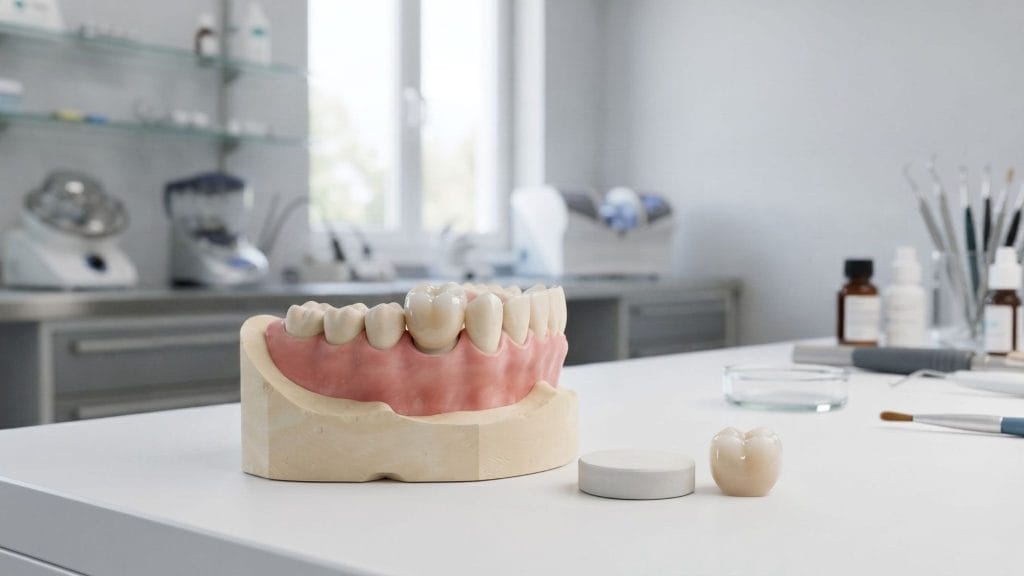
Full contour zirconia, also called monolithic zirconia material, is a single block of zirconia milled into the final shape of a crown or bridge with no porcelain layering on top. The entire restoration, from the occlusal surface to the margin, is made of the same solid material.
This is different from layered or “PFZ” (porcelain-fused-to-zirconia) restorations, where a zirconia coping is veneered with layered ceramic for aesthetics. Full contour eliminates that layering step.
Key characteristics of full contour zirconia:
- Milled as one solid piece from a zirconia disc or block
- No porcelain veneer layer, which removes the risk of chipping or delamination
- Available in multiple translucency levels for different aesthetic zones
- Compatible with digital workflows, including intraoral scanning and CAD/CAM design
- Suitable for both anterior and posterior restorations, depending on the generation of zirconia used
How Does Full Contour Zirconia Differ From Traditional Layered Zirconia?
The biggest difference comes down to structure. Layered zirconia uses a strong zirconia substructure covered in weaker, more chip-prone porcelain. Full contour zirconia crowns skip that layer completely.
Here’s how the two compare in practice:
- Chipping risk: Layered zirconia has a documented chipping rate on the porcelain veneer, sometimes reported in clinical studies between 5 and 15 percent over several years. Full contour eliminates this failure mode almost entirely.
- Strength: Monolithic zirconia typically tests at 800 to over 1,200 MPa flexural strength depending on the generation, compared to porcelain veneers that fracture at a fraction of that load.
- Preparation depth: Full contour restorations need less occlusal reduction, often as little as 0.5 to 1.0 mm, which preserves more natural tooth structure.
- Turnaround time: Skipping the layering step shortens lab production time, which matters for practices managing case volume.
- Aesthetics: Traditional layered zirconia historically had an aesthetic edge, but modern multilayer and high-translucency zirconia discs have closed most of that gap.
Why Is Full Contour Zirconia So Widely Used Today?
Full contour zirconia solved a real clinical problem. Before it became mainstream, dentists had to choose between strong-but-opaque zirconia copings and porcelain that looked natural but chipped under load.
The material’s popularity today comes down to a few practical advantages:
- It handles high occlusal forces, which makes it a reliable choice for molars and bruxism patients
- It requires a single milling step, reducing chair time and lab turnaround
- Newer multilayer discs blend shade and translucency gradients into one block, closing the aesthetic gap with layered restorations
- It performs consistently across a wide range of case types, from single crowns to long-span bridges
- It fits naturally into fully digital workflows, from scan to design to mill
Which Generations of Full Contour Zirconia Exist, and How Do They Differ?
Zirconia has evolved through several generations, and understanding them helps you match the material to the case instead of defaulting to one product for everything.
- First generation (3Y-TZP): High strength, lower translucency. Best suited for posterior crowns and bridges where strength matters more than aesthetics.
- Second generation (partially stabilized, higher translucency): A blend of strength and improved light transmission, useful for premolars and less visible molars.
- Third generation (5Y-PSZ, cubic-content zirconia): Higher translucency approaching lithium disilicate, with somewhat lower flexural strength. Popular for anterior full-contour crowns.
- Fourth generation (multilayer, gradient shading discs): Combines strength zones near the gingival margin with translucency zones at the incisal edge, all in one puck.
Choosing between these generations is one of the most common questions dentists ask their lab. A knowledgeable full contour crown material partner should be asking about the tooth position, occlusal load, and shade requirements before recommending a disc type.
When Should You Choose Full Contour Zirconia Over Other Restorative Materials?
Full contour zirconia isn’t the right answer for every case, but it’s frequently the right answer for these situations:
- Posterior crowns and bridges where occlusal load is high
- Patients with a history of bruxism or parafunctional habits
- Implant-supported restorations where screw access and structural integrity matter
- Cases with limited interocclusal space, since full contour zirconia needs less reduction than PFM or layered ceramic
- Long-span bridges where flexural strength determines whether the restoration survives long term
- Patients who need a durable, lower-maintenance option and don’t want repeat visits for chip repair
For highly visible anterior teeth where translucency is the top priority, lithium disilicate or high-translucency multilayer zirconia may be a better fit, depending on the shade match needed.
How Strong Is Full Contour Zirconia Compared to Other Crown Materials?
Strength is usually the first question dentists ask, and it’s a fair one given how much force molars absorb during normal function. Monolithic zirconia material consistently outperforms PFM porcelain and lithium disilicate on flexural strength testing.
- Full contour zirconia: roughly 800 to 1,200+ MPa, depending on generation
- Lithium disilicate: roughly 360 to 500 MPa
- Feldspathic porcelain: roughly 60 to 100 MPa
- PFM (porcelain-fused-to-metal): strong metal substructure, but the porcelain veneer remains the weak point for chipping
These numbers explain why full contour zirconia has become the go-to material for posterior restorations and why many labs now recommend it as a default for bruxers and heavy occlusal cases.
What Should Dentists Look for When Selecting a Full Contour Zirconia Lab Partner?
Material quality matters, but so does the lab producing the restoration. A few factors separate a reliable partner from an inconsistent one:
- Documented flexural strength and sourcing for the zirconia discs used
- A digital workflow that supports your intraoral scanner and design software
- Clear communication about which generation of zirconia fits a given case
- Consistent shade matching across multiple units, especially for full-arch and multi-unit cases
- Reasonable turnaround time without sacrificing fit or margin accuracy
- A warranty that reflects confidence in the material and the milling process
Why Partner With Zirconia Express for Full Contour Zirconia Restorations?
Choosing the right zirconia isn’t just about the disc itself. It’s about whether your lab partner understands how to match material generation, translucency, and design to the specific case in front of you.
Zirconia Express, based in North Carolina, works with dentists, prosthodontists, implant dentists, and dental laboratories who need consistent, predictable outcomes on every case. The lab’s zirconia crowns and bridges are produced from high-strength zirconia and backed by up to a five-year warranty, so practices aren’t gambling on material performance.
For teams running a digital workflow, Zirconia Express also offers digital dental cases built with an AI-driven design system and three anatomical shape options, giving clinicians more control over occlusal anatomy without slowing down turnaround. Every case moves through a digital pipeline built for accuracy, from scan intake to final milling.
What this means in practice for a busy practice:
- Fewer remakes, thanks to consistent shade and fit across units
- Faster case turnaround without cutting corners on quality control
- A material warranty that protects the practice, not just the lab
- Design flexibility through AI-assisted anatomical shaping
- A workflow built to integrate with existing digital scanning systems
If your practice is evaluating lab partners for full contour zirconia cases, it’s worth reaching out to Zirconia Express to discuss case requirements and see how their digital workflow fits your process.
Conclusion
Full contour zirconia materials have earned their place as a first-choice restorative option because they combine high strength, digital workflow compatibility, and aesthetics that continue to improve with each new generation of discs. Understanding the differences between generations and matching them to the right clinical situation is what separates a restoration that lasts from one that needs to be remade.
Working with a lab that understands full contour zirconia crowns at this level of detail, rather than treating every case the same way, tends to produce better long-term outcomes for both the practice and the patient. As material science keeps advancing, the gap between strength and aesthetics will likely keep narrowing, making full contour zirconia an even easier recommendation for a wider range of cases.
FAQ’s
Is full-contour zirconia stronger than porcelain-fused-to-metal crowns?
Full contour zirconia typically has higher flexural strength than the porcelain layer used in PFM crowns, and it removes the chipping risk associated with that porcelain layer entirely, since the entire restoration is milled from one solid block.
How much tooth reduction is needed for a full-contour zirconia crown?
Full contour zirconia crowns generally require less occlusal reduction than layered restorations, often between 0.5 and 1.0 mm, which helps preserve more natural tooth structure during preparation.
Can full-contour zirconia be used for anterior teeth?
Yes. Newer high-translucency and multilayer zirconia discs are designed specifically for anterior use, offering improved light transmission while retaining more strength than traditional glass ceramics.
How long do full contour zirconia crowns typically last?
With proper case selection and occlusal adjustment, full contour zirconia crowns commonly last 10 to 15 years or longer, and their resistance to chipping makes long-term maintenance simpler than layered alternatives.
What is the difference between monolithic zirconia and multilayer zirconia?
Monolithic zirconia is milled from a single, uniform disc, while multilayer zirconia discs blend different strength and translucency zones into one puck, giving the crown a more natural gradient from the gum line to the incisal edge without sacrificing structural strength.