

Anterior Full Contour Zirconia Crowns: Expert Lab Guide
Anterior Full Contour Zirconia has changed how dental labs approach front tooth restorations. It combines the strength dentists need with the translucency patients expect, all in a single milled piece. This guide breaks down what it is, how it’s made, and why more clinicians are specifying it for anterior cases.
Front tooth restorations carry a different kind of pressure than back tooth work. Patients notice every shift in shade, every edge, and every reflection when they smile in natural light. That’s why material selection and lab precision matter so much in this part of the mouth. Getting it right the first time saves both the dentist and the patient a lot of frustration.
If you’ve ever hesitated to place zirconia in the smile zone because of esthetic concerns, this article will show you how far the material has come. We’ll also cover the lab side of production, since that’s where most of the quality difference actually happens.
What Is Anterior Full Contour Zirconia?
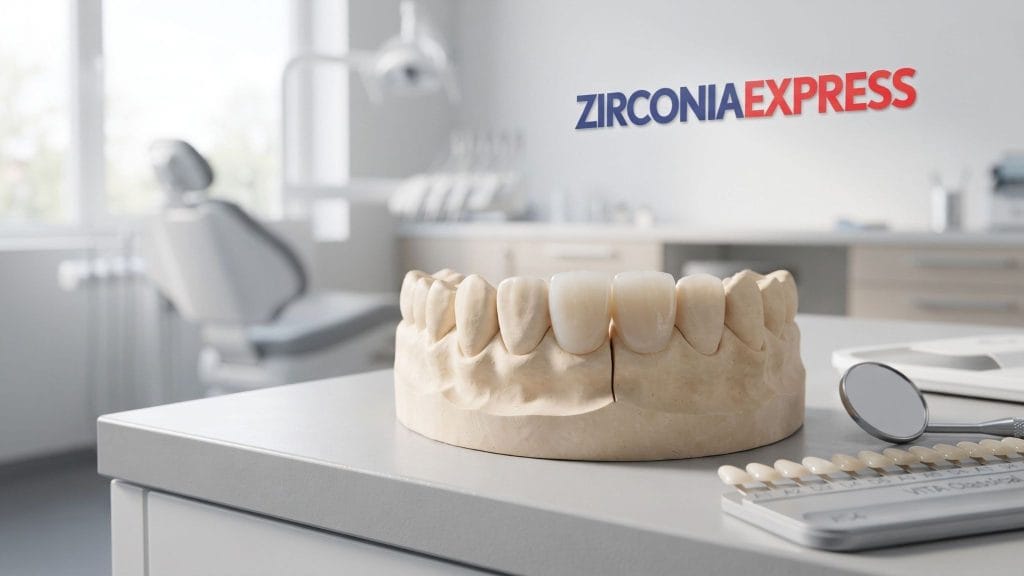
Anterior Full Contour Zirconia is a crown milled entirely from a single block of zirconia, then stained and glazed (or layered with porcelain in select areas) to match the surrounding dentition. Unlike traditional zirconia crowns that require a porcelain overlay for shape and color, full contour zirconia is milled to its final anatomical form.
This means the restoration doesn’t rely on a fused porcelain layer for strength or shape. The zirconia itself carries the load and the esthetic outcome, which reduces the risk of chipping that comes with layered systems.
Modern multilayer anterior zirconia blocks are engineered with a gradient of shades and translucency built directly into the puck. The cervical area is more opaque to mimic dentin, while the incisal edge is more translucent to mimic enamel. This gradient is what allows full contour restorations to look natural without hand layering.
Why Do Dentists Choose Full Contour Anterior Crowns?
Dentists move toward full contour anterior crowns for a few practical reasons, and most of them come down to predictability. A monolithic restoration behaves consistently from patient to patient, which matters when esthetic expectations are high and chair time is limited.
Here’s what typically drives the decision:
- Reduced risk of porcelain chipping or delamination
- Thinner preparation requirements in some cases
- Faster turnaround from the lab since layering steps are minimized
- Strong performance under parafunctional forces like clenching or grinding
- Predictable shade matching using digital shade mapping
For patients with bruxism or a history of fractured crowns, full contour zirconia often becomes the default recommendation rather than the exception.
How Strong Is Anterior Full Contour Zirconia Compared to Other Materials?
Strength is where zirconia has always had an edge. Traditional 3Y zirconia (the high strength category) can exceed 1,000 MPa in flexural strength, while newer 4Y and 5Y esthetic zirconias used for anterior cases typically range between 550 and 800 MPa depending on the manufacturer and layer.
By comparison, lithium disilicate (a common alternative for anterior restorations) sits closer to 360 to 400 MPa. Even the more esthetic 5Y zirconia formulations, which sacrifice some strength for translucency, still outperform most glass ceramics used in the same clinical situations.
This strength margin matters most in cases involving:
- Long span anterior bridges
- Patients with heavy occlusal contact on lingual surfaces
- Thin preparations where material thickness is limited
- Implant-supported anterior restorations under lateral load
What Makes Multilayer Anterior Zirconia Different?
Multilayer anterior zirconia is not a single material. It’s a manufacturing approach where several zirconia formulations, each with different strength and translucency properties, are combined into one puck during production.
The result is a block that transitions gradually from a stronger, more opaque base to a softer, more translucent incisal edge. When a lab mills a crown from this puck and positions it correctly within the block, the finished restoration mimics natural tooth structure without additional layering work.
This is a meaningful shift from older monolithic zirconia, which came in a single uniform shade and often looked flat or opaque in the smile zone. Multilayer technology solved that problem while keeping the structural advantages of a milled, one-piece restoration.
When Should You Choose Anterior Zirconia Restorations?
Anterior zirconia restorations aren’t the right fit for every case, but they excel in specific clinical situations. Understanding when to reach for zirconia versus an alternative material saves chair time and reduces remake rates.
Zirconia tends to be the stronger choice when:
- The patient has a documented history of bruxism or clenching
- The case involves a long span bridge rather than a single unit
- Preparation space is limited and material thickness needs to work harder
- The restoration sits over an implant with less shock absorption than a natural tooth
- Durability needs to outweigh the very last degree of translucency
Glass ceramics may still be preferred for single central incisors in patients with minimal occlusal load and very high esthetic demands, where translucency is the top priority.
How Are Anterior Zirconia Crowns Fabricated in the Lab?
The fabrication process for anterior zirconia crowns has become highly digital, but precision still depends heavily on lab expertise at each step. Here’s the general workflow most labs follow:
- A digital scan or physical impression is captured and converted into a digital model
- The crown is designed in CAD software with attention to contact points, contour, and incisal edge position
- The block or puck is selected based on shade, translucency, and strength requirements for the case
- The restoration is milled from the zirconia puck using a wet milling process to reduce microcracking
- The crown undergoes sintering, a high heat process that densifies the zirconia and brings it to full strength
- Staining, characterization, and glazing are applied to match the surrounding dentition
- Final quality checks confirm fit, contact, and shade before shipping to the dental practice
Sintering is often the step that separates a well-made restoration from a mediocre one. Temperature and timing directly affect final strength and translucency, so labs that control this process tightly produce more consistent results case after case.
What Are the Key Anterior Zirconia Crown Benefits?
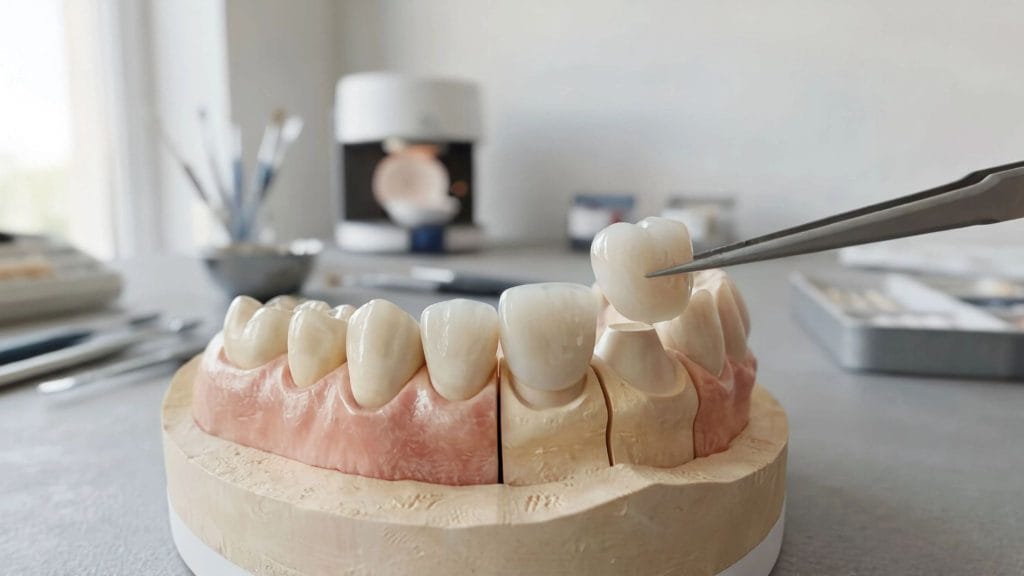
Understanding anterior zirconia crown benefits helps dentists explain treatment options to patients with confidence. The advantages go beyond strength alone.
- Excellent biocompatibility with minimal risk of gingival irritation
- Stain resistance that helps color stay stable over years of function
- Lower plaque affinity compared to some other restorative materials
- Compatibility with digital workflows from scan to final crown
- Wide shade range that supports accurate matching in the anterior zone
- Long-term value, since well-made zirconia restorations often outlast alternatives
These benefits compound over time. A crown that resists staining and chipping means fewer remakes, fewer emergency visits, and a better long-term outcome for the patient.
Which Is Better: Full Contour Zirconia or Layered Porcelain?
This question comes up constantly, and the honest answer depends on the case. Layered porcelain, applied over a zirconia or metal substructure, can achieve exceptional translucency and is often favored for a single, highly visible central incisor.
Full contour zirconia, on the other hand, offers superior strength and eliminates the delamination risk that comes with a separate porcelain layer. For bridges, bruxism patients, or cases where durability is a priority, full contour is generally the stronger clinical choice.
Many labs now recommend a hybrid approach for select cases, applying light incisal characterization over a full contour zirconia base to combine strength with a bit of extra translucency where it’s needed most.
Why Partner With Zirconia Express for Anterior Zirconia Cases?
Choosing a lab partner for anterior work is as important as choosing the material itself. Even the best zirconia can underperform if milling, sintering, or shade mapping isn’t handled with precision.
Zirconia Express, based in North Carolina, works with dentists, prosthodontists, implant specialists, and dental laboratories across the country to produce anterior and posterior zirconia crowns and bridges built for both strength and esthetics. Every case is backed by up to a 5-year warranty, giving practices confidence in the durability of what they deliver to patients.
For practices running digital workflows, Zirconia Express also offers Digital Dental Cases powered by an AI-driven design system, with three anatomical shape options to fit different smile styles and patient needs. This combination of high-precision design and dependable turnaround helps practices reduce remakes and keep case schedules on track.
Whether you’re placing a single anterior crown or planning a full arch case, working with a lab that understands the nuances of anterior esthetics makes a measurable difference. Reach out to Zirconia Express to discuss your next case and see how consistent quality and reliable turnaround can support your practice.
Conclusion
Anterior Full Contour Zirconia has earned its place in modern restorative dentistry by solving the old trade-off between strength and esthetics. With multilayer blocks, precise digital design, and controlled sintering, today’s full contour crowns hold up under function while still looking like natural teeth.
For dentists evaluating options, Full Contour Anterior Crowns offer a dependable path forward, particularly in cases involving bruxism, bridges, or limited preparation space. Working with an experienced lab that understands shade mapping, block selection, and sintering protocols is what turns a good material into a great final restoration.
FAQ’s
Is Anterior Full Contour Zirconia strong enough for front teeth?
Yes. Modern anterior zirconia formulations range from roughly 550 to 800 MPa in flexural strength, which is significantly higher than lithium disilicate and more than sufficient for front tooth function, even in patients with bruxism.
Does full contour zirconia look natural in the smile zone?
Yes, when milled from a quality multilayer block and finished by an experienced lab. The built-in shade gradient, combined with proper staining and glazing, produces a natural translucency gradient from cervical to incisal.
How long do anterior zirconia crowns typically last?
With proper care and occlusal management, anterior zirconia crowns commonly last well over a decade. Many labs, including Zirconia Express, back their restorations with warranties of up to 5 years to reflect this durability.
What is the difference between monolithic and multilayer zirconia?
Monolithic zirconia uses a single uniform shade throughout the block, while multilayer zirconia blends multiple shades and translucency levels into one puck. Multilayer blocks generally produce more natural-looking anterior restorations.
Can zirconia crowns be used for anterior bridges?
Yes. Full-contour zirconia is a common choice for anterior bridges because of its high flexural strength, which helps the restoration withstand the added stress of spanning multiple units without a metal substructure.