
Why Choose High-Strength Monolithic Zirconia?
When a dental restoration needs to handle strong bite forces without sacrificing a clean, natural appearance, material selection matters. High-strength monolithic zirconia has become an important option for dentists who need durable crowns and bridges that can perform under demanding clinical conditions.
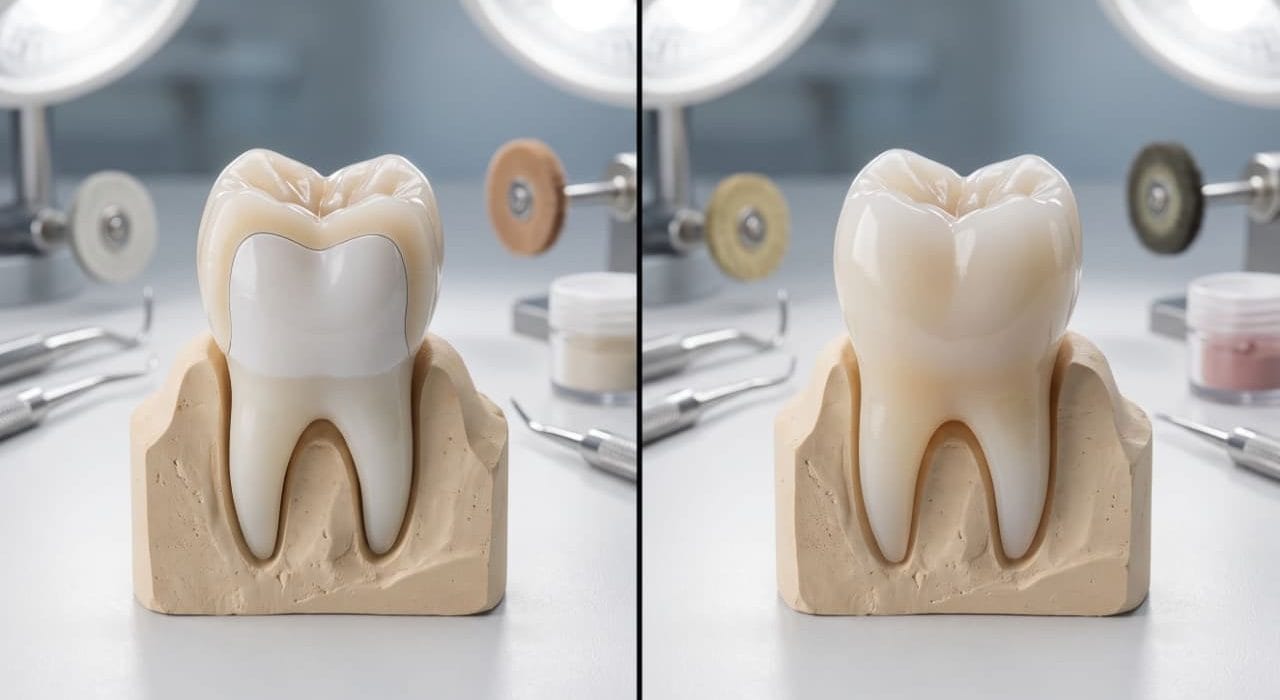
Unlike layered restorations that combine a zirconia framework with veneering porcelain, monolithic zirconia is designed from a single zirconia structure. This eliminates a separate porcelain layer and can reduce the risk of veneer-related chipping.
For dentists, the appeal goes beyond strength. Modern zirconia materials can offer a practical combination of durability, digital precision, efficient fabrication, and improved esthetics. The right material still depends on the individual case, preparation, occlusion, location, and esthetic requirements.
This guide explains what makes high-strength monolithic zirconia different, where it fits clinically, and what dentists should consider when selecting a dental laboratory for these restorations.
What Is High-Strength Monolithic Zirconia?
High-strength monolithic zirconia is a zirconia restoration manufactured from a single piece of zirconium dioxide rather than a zirconia core covered with a separate porcelain veneer.
The term “monolithic” refers to the restoration’s single-material structure. The crown or bridge is digitally designed and milled from a zirconia blank, followed by the appropriate sintering, finishing, polishing, staining, or glazing processes.
This construction gives the restoration a continuous zirconia structure. There is no veneering porcelain that can separate from the underlying framework.
For dentists, this can make monolithic zirconia particularly useful in situations where functional demands are high.
Key Characteristics of High-Strength Monolithic Zirconia
| Characteristic | Clinical Relevance |
| Monolithic construction | No separate porcelain veneer layer |
| High strength | Suitable for demanding functional areas |
| Fracture resistance | Supports durability under occlusal forces |
| Digital fabrication | Enables CAD/CAM-based production |
| Custom anatomy | Allows digitally designed occlusal and tooth morphology |
| Metal-free composition | Useful when a metal-free restoration is preferred |
| Finishing options | Can be polished, stained, or glazed depending on the case |
The specific properties of a zirconia restoration depend on the zirconia formulation, design, thickness, manufacturing process, and clinical application. Dentists should therefore select the material based on the complete restorative plan rather than strength alone.
Why Choose High-Strength Monolithic Zirconia?
The main reason dentists consider high-strength monolithic zirconia is its combination of mechanical performance and efficient digital fabrication.
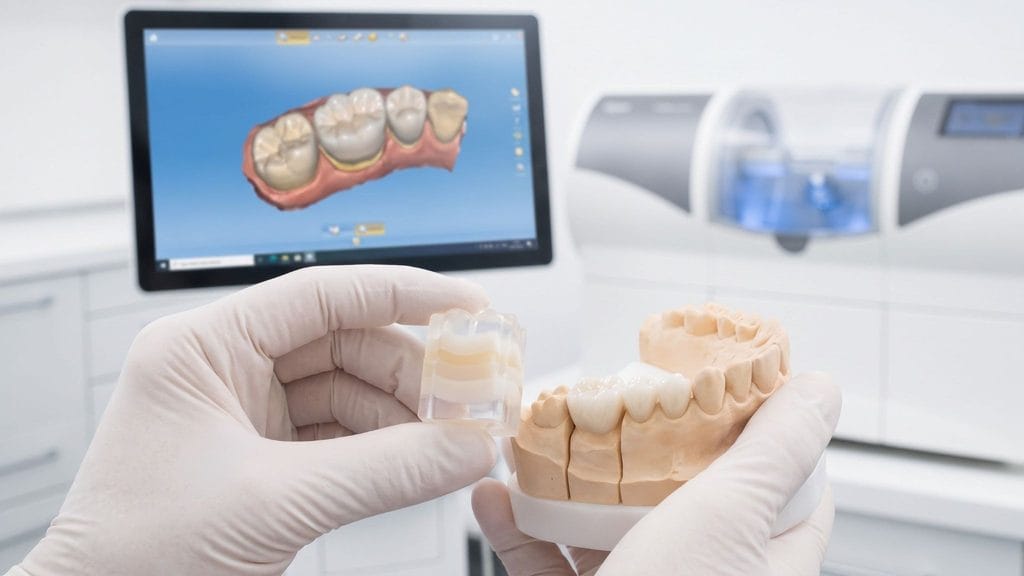
A restoration can be designed digitally, milled from a zirconia blank, sintered, and finished according to the laboratory’s workflow. Because the restoration does not depend on a separately veneered porcelain surface, the construction can be particularly useful when functional durability is a major concern.
1. Strong Performance Under Occlusal Forces
Posterior teeth experience substantial chewing forces. Patients who clench or grind may place even greater demands on a restoration.
This is where high-strength zirconia crowns can provide a practical restorative option. Their monolithic construction is designed to support functional demands without relying on a veneering porcelain layer.
Dentists may consider high-strength monolithic zirconia for posterior crowns, selected bridge cases, and other restorations where strength is an important treatment consideration.
2. Reduced Veneering-Related Chipping
Layered restorations contain a zirconia or ceramic framework with an additional porcelain veneer. While this approach can provide excellent characterization and esthetics, the veneering material introduces another interface within the restoration.
Monolithic zirconia takes a different approach.
The functional surface remains zirconia rather than veneering porcelain. This removes one potential source of porcelain chipping or delamination associated with layered designs.
That does not mean monolithic zirconia is immune to complications. Proper preparation, material selection, occlusal design, sintering, finishing, and polishing remain important to long-term performance.
3. Efficient Digital Production
Modern dental laboratories use CAD/CAM systems to design and manufacture zirconia restorations with a high level of digital control.
For monolithic zirconia crowns, the workflow can begin with an intraoral scan or laboratory scan. The digital case is then designed according to the prescribed anatomy, contacts, occlusion, and restoration requirements.
The design is transferred to a milling system before the zirconia is sintered and finished.
This digital workflow can help laboratories maintain consistency from case design through manufacturing while giving dentists a more streamlined way to submit cases.
High-Strength Dental Zirconia vs. Other Zirconia Options
Not every zirconia restoration is manufactured for the same purpose. Modern zirconia products can differ in translucency, strength, composition, and intended clinical application.
High-strength dental zirconia generally prioritizes mechanical performance, making it particularly relevant when functional demands are high.
More translucent zirconia formulations may prioritize optical properties. Some modern materials attempt to balance strength and translucency, allowing dentists and laboratories to select an appropriate option based on the location and requirements of the restoration.
This is why dentists should avoid treating “zirconia” as a single material category.
The right question is not simply:
Is zirconia strong?
It is:
Which zirconia formulation and restoration design are appropriate for this specific case?
Factors such as tooth position, occlusal forces, available clearance, restoration design, esthetic expectations, and the laboratory’s manufacturing workflow all matter.
Is High-Strength Monolithic Zirconia the Strongest Zirconia for Dental Crowns?
Dentists often search for the strongest zirconia for dental crowns, but strength should not be the only selection criterion.
Different zirconia formulations are engineered with different balances between strength and optical characteristics. Higher strength can be particularly valuable in posterior and high-load situations, while anterior cases may place greater emphasis on translucency and shade integration.
A practical material-selection process should therefore consider:
- Location of the restoration
- Patient’s occlusal forces
- Bruxism or clenching
- Available restorative space
- Required restoration thickness
- Esthetic expectations
- Shade requirements
- Type of restoration
- Digital design and manufacturing capabilities
In other words, the strongest available material is not automatically the correct material for every patient.
The laboratory and dentist should work together to select a zirconia solution that fits the clinical requirements.
High-Flexural-Strength Zirconia for Demanding Restorations
One of the important technical characteristics dentists consider when evaluating zirconia is flexural strength.
High-flexural-strength zirconia is designed to withstand bending forces before fracture. This property is particularly relevant when restorations need to tolerate significant functional loading.
For this reason, high-strength zirconia can be considered for selected posterior restorations and other cases where durability is a primary concern.
However, laboratory quality control is equally important. A strong zirconia blank still needs to be correctly designed, milled, sintered, finished, and polished.
Poorly controlled manufacturing can compromise the performance of even a high-quality material.
Monolithic Zirconia Crowns for Posterior Dentistry
Posterior restorations often require a careful balance between strength, occlusal anatomy, fit, and appearance.
Monolithic zirconia crowns can be useful in these cases because the restoration is produced as one continuous zirconia structure.
They may be considered for:
- Posterior single crowns
- Molars and premolars
- Patients with significant occlusal loading
- Selected patients with bruxism
- Cases where durability is a major priority
- Selected multi-unit restorations
- Cases requiring digitally fabricated restorations
The final decision should always be based on the patient’s clinical situation and the dentist’s treatment plan.
What About Esthetics?
A common historical criticism of high-strength zirconia was its relatively limited translucency compared with more translucent restorative materials.
Modern zirconia technology has expanded the range of available optical properties.
Today’s zirconia materials can offer improved translucency, multilayer shading, and more natural color transitions. This means dentists have more options when they need to balance strength with appearance.
For highly demanding anterior cosmetic cases, a different zirconia formulation or layered restoration may be appropriate. For posterior cases, high-strength monolithic zirconia can provide a useful combination of function and acceptable esthetics.
The key is matching the material to the case instead of using the same restoration for every clinical situation.
High-Strength Monolithic Zirconia vs. Layered Zirconia
The fundamental difference is the construction.
High-strength monolithic zirconia uses a single zirconia structure. Layered zirconia uses a zirconia framework with porcelain applied over the surface.
| Factor | High-Strength Monolithic Zirconia | Layered Zirconia |
| Construction | Single zirconia structure | Zirconia core + porcelain |
| Functional focus | High | High, depending on design |
| Veneer chipping concern | No veneering porcelain | Veneering porcelain can chip |
| Digital workflow | Highly compatible | Compatible, with additional layering |
| Characterization | Staining/glazing and digital design | Detailed porcelain characterization |
| Common consideration | Posterior and high-load cases | Highly esthetic cases |
Neither option should be treated as universally superior. The right choice depends on the restoration’s clinical objectives.
High-Strength Monolithic Zirconia and Digital Dentistry
Digital dentistry has changed how dental laboratories receive, design, and manufacture restorative cases.
At Zirconia Express, dentists can submit digital dental cases through a streamlined laboratory workflow. Digital files can help the laboratory work from precise patient information while supporting efficient CAD-based restoration design.
Digital workflows are particularly valuable when dentists want consistency across case submission, design, communication, and manufacturing.
For dentists using digital impressions, a laboratory that understands digital case workflows can make the process more predictable and efficient.
Why Laboratory Quality Matters
Material selection is only one part of a successful zirconia restoration.
The laboratory’s workflow also matters.
A high-quality restoration depends on several stages, including:
- Accurate digital case information
- Proper restoration design
- Appropriate zirconia selection
- Precise milling
- Controlled sintering
- Accurate contacts and occlusion
- Proper finishing and polishing
- Appropriate shade characterization
- Quality-control inspection
This is especially important for high-strength monolithic zirconia, where the final result depends on more than the strength rating of the raw material.
Dentists should look for a laboratory that combines reliable materials with digital design, experienced technicians, consistent manufacturing, and clear case communication.
Why Dentists Choose Zirconia Express for Crowns and Bridges
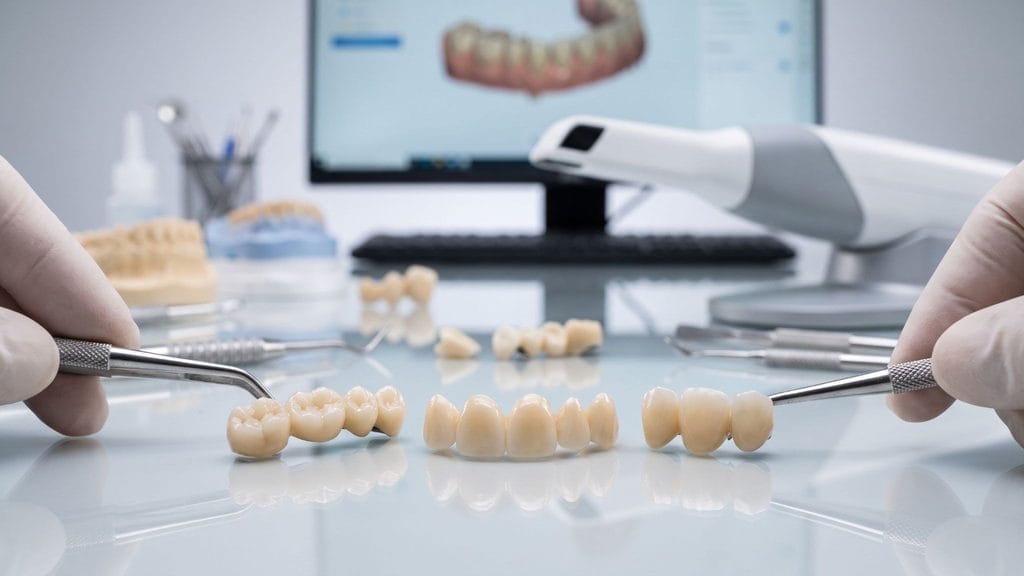
For dentists who need reliable zirconia restorations, Zirconia Express provides B2B dental laboratory services focused on digital workflows and restorative consistency.
Our zirconia crowns and bridges come with up to a 5-year warranty, giving dental practices additional support when ordering qualifying restorations.
The workflow is designed around the needs of dental professionals, from digital case submission through restoration fabrication.
For practices that want to make digital dentistry a larger part of their workflow, Zirconia Express also provides digital dental cases supported by an AI-driven design system with three anatomical shape options.
This gives dentists another way to streamline digital restorative workflows while maintaining control over the clinical prescription.
Order Your Dental Crowns and Bridges Through Zirconia Express
When your case requires durable zirconia crowns or bridges, working with a specialized dental laboratory can simplify the restorative workflow.
Zirconia Express supports dentists with digitally fabricated zirconia crowns and bridges, backed by up to a 5-year warranty on qualifying restorations.
You can also submit your digital dental cases to take advantage of an AI-driven design workflow with three anatomical shape options.
For dentists looking for a reliable laboratory partner for zirconia restorations, Zirconia Express provides a direct B2B workflow designed around dental practices and professional case requirements.
Conclusion
High-strength monolithic zirconia gives dentists a practical restorative option when strength, durability, and digital manufacturing are important priorities.
Its single-material construction eliminates the need for a separate veneering porcelain layer, while modern zirconia technologies offer improved optical properties compared with earlier generations of high-strength zirconia.
For posterior crowns and selected demanding restorative cases, it can provide a useful combination of functional performance, efficient fabrication, and contemporary esthetics.
The best restoration still depends on the individual case. By combining appropriate material selection with accurate digital design, controlled laboratory manufacturing, and careful clinical planning, dentists can create restorations designed around both patient needs and long-term function.
For dental practices seeking a dependable laboratory partner, Zirconia Express offers zirconia crowns and bridges with up to a 5-year warranty, along with digital dental cases powered by an AI-driven design system and three anatomical shape options.
FAQ’s
What is high-strength monolithic zirconia?
High-strength monolithic zirconia is a dental restoration manufactured from a single zirconia structure rather than a zirconia framework covered with veneering porcelain. It is commonly considered when durability and resistance to functional forces are important.
Are monolithic zirconia crowns good for molars?
Monolithic zirconia crowns can be suitable for selected molar restorations because posterior teeth experience significant chewing forces. The dentist should evaluate occlusion, preparation, clearance, material selection, and patient-specific factors before choosing the restoration.
Is high-strength zirconia suitable for bruxism?
High-strength zirconia may be considered for patients with bruxism because of its mechanical properties. However, material selection should be combined with appropriate preparation, occlusal planning, restoration design, and patient management.
Is monolithic zirconia more durable than layered zirconia?
Monolithic zirconia eliminates the veneering porcelain layer, which can reduce the risk of veneer-related chipping. However, durability depends on the material, restoration design, manufacturing process, occlusion, preparation, and clinical conditions.
Is the strongest zirconia always the best choice?
No. Strength is only one factor in material selection. Dentists should also consider translucency, esthetics, restoration location, occlusal forces, available space, patient needs, and the specific zirconia formulation.