
Why Dentists Recommend BruxZir Implant Crowns for Back Teeth
A molar implant crown takes a beating. Every chew cycle loads it with forces that a front tooth restoration never sees, which is why so many implant dentists default to a BruxZir implant crown when restoring the posterior arch.
This isn’t a trend built on marketing. It’s built on a decade of clinical data showing that monolithic zirconia holds up where layered porcelain often fails. For dentists and labs weighing material options for their next implant case, understanding why this specific zirconia has become the posterior standard matters.
What Is a BruxZir Implant Crown?
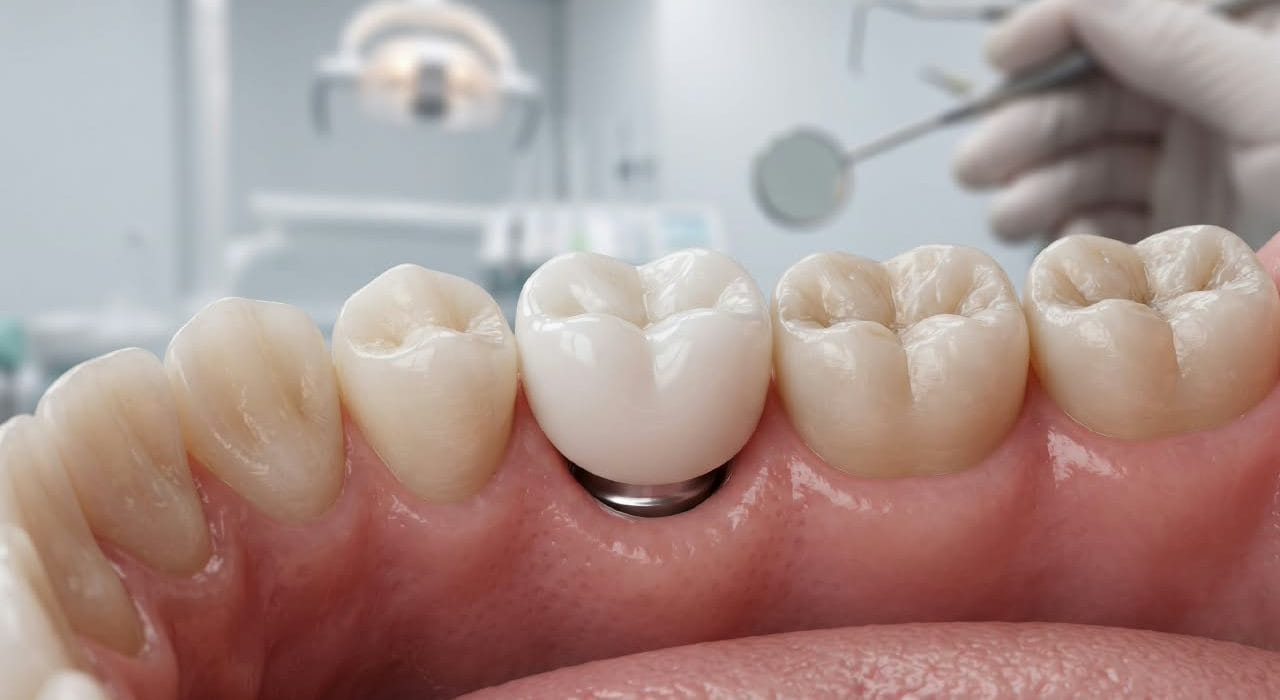
A BruxZir implant crown is a full-contour restoration milled from a single block of solid zirconia and designed to attach directly, either by screw retention or cementation, onto a custom abutment. Unlike layered zirconia crowns, there’s no porcelain veneer stacked on top.
The entire crown, from the occlusal surface down to the margin, is one uniform block of BruxZir zirconia. That construction is exactly why it holds up to the forces implant patients generate every day.
BruxZir is a specific brand of zirconia manufactured by Glidewell, and it was among the first monolithic zirconia crown materials to gain widespread adoption in U.S. dental labs. Since its introduction, it’s become something of a shorthand term in the industry for a BruxZir solid zirconia crown, even when other manufacturers produce comparable materials.
Why Do Dentists Choose Zirconia Implant Crowns for Molars Specifically?
Back teeth do the heavy lifting during mastication. Molars can generate bite forces exceeding 200 pounds in some patients, and implant-supported teeth lack the natural shock absorption a periodontal ligament provides on a natural tooth root.
That combination of high force and no cushioning is precisely where weaker materials tend to chip or fracture. A zirconia implant crown addresses this because monolithic zirconia has flexural strength that regularly exceeds 1,000 MPa, compared to roughly 100–150 MPa for feldspathic porcelain.
There’s also the matter of implant protection. A crown that fractures under load doesn’t just cost the patient a remake; it can transmit unexpected stress to the implant-abutment connection. Dentists who’ve dealt with porcelain fractures on posterior implants tend to switch to solid zirconia after the first remake, not the third.
What Makes BruxZir Full Strength Zirconia Different From Standard Zirconia?
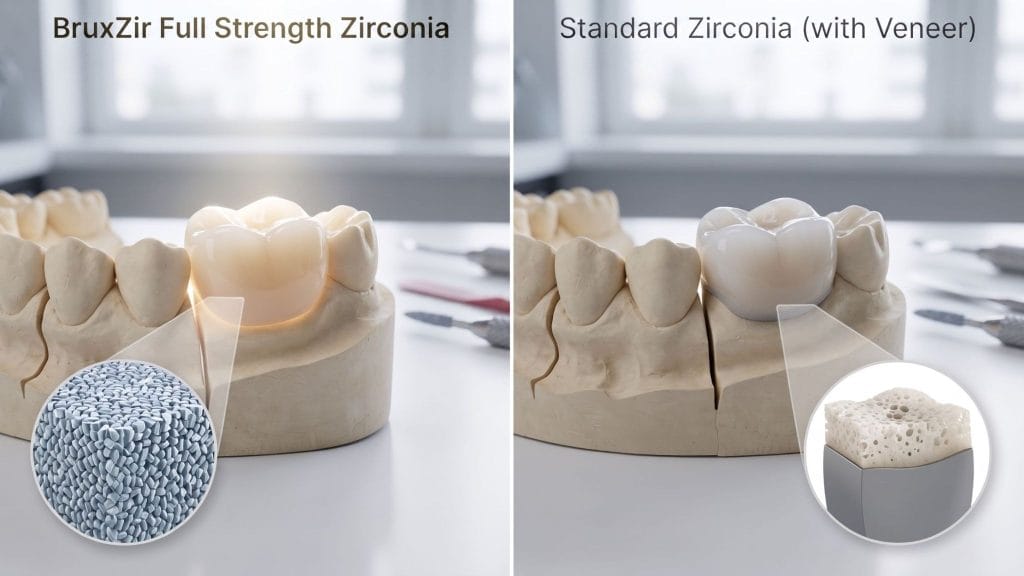
Not all zirconia is created equal, and this distinction matters more than most patients realize. BruxZir full strength zirconia refers to a formulation engineered specifically for high-stress posterior applications, as opposed to the more translucent, lower-strength zirconia used for anterior esthetic cases.
Higher-strength zirconia formulations typically sacrifice some translucency to gain fracture resistance. That trade-off makes sense for a molar, where the tooth is barely visible, and durability outweighs cosmetic subtlety. For anterior teeth, labs generally shift to a more translucent, lower-strength zirconia layered or characterized for esthetics.
This is why a knowledgeable lab technician will ask which tooth position a crown is for before selecting the zirconia formulation. Using a high-translucency, lower-strength material on a molar wastes the strength advantage that made zirconia worth choosing in the first place.
How Does a Monolithic Zirconia Crown Resist Fracture Better Than Layered Restorations?
A monolithic zirconia crown is milled as one solid piece, with no interface between materials. Layered restorations, by contrast, have a porcelain veneer bonded or fused over a coping and that interface is the weak point.
Delamination, chipping, and cracking almost always originate at a layering interface, not within a solid block. Monolithic zirconia crowns eliminate that failure point because there’s nothing to delaminate.
This matters even more on implants than on natural teeth. Since there’s no periodontal ligament to absorb micro-movement, forces travel through the restoration more directly. A single-material crown distributes that load more evenly across its structure instead of concentrating stress at a bonded seam.
What Clinical Advantages Does a BruxZir Solid Zirconia Crown Offer on Implants?
Beyond raw strength, a BruxZir solid zirconia crown brings several practical benefits that implant dentists notice chairside:
- Minimal occlusal adjustment risk. Because the crown is solid material throughout, adjusting the bite doesn’t expose an underlying substructure or weaken a porcelain layer.
- Predictable wear characteristics. Properly polished zirconia is gentle on opposing dentition, reducing concerns about accelerated wear of natural teeth.
- Simplified retrievability. Screw-retained BruxZir crowns can be removed for maintenance without damaging the restoration, which matters for long-term implant care.
- Consistent fit. CAD/CAM milling from a solid block produces tighter, more repeatable margins than hand-layered techniques.
These advantages compound over time. A crown that doesn’t chip, doesn’t need frequent adjustment redos, and can be retrieved cleanly saves both chair time and patient trust.
When Should a Dentist Choose a Zirconia Implant Crown Over Other Materials?
Material selection should follow the clinical situation, not habit. A zirconia implant crown makes the most sense when:
The restoration sits in the posterior region, where occlusal forces are highest and esthetic demands are lower. The patient has a documented history of bruxism or parafunctional habits, since solid zirconia resists the fracture patterns common in clenching and grinding. The case requires long-term durability, such as for patients unlikely to return frequently for maintenance.
Conversely, for a highly visible anterior implant where subtle translucency and light transmission matter more than maximum strength, a lithium disilicate crown or a layered zirconia restoration may be a better esthetic match. Good implant dentistry means matching the material to the tooth position and the patient’s functional demands, not defaulting to one material for every case.
Occlusal clearance also plays a role in this decision. Cases with limited interocclusal space, common after long-term edentulism or opposing over-eruption, often favor a monolithic zirconia crown because it can be milled thinner than a layered restoration while still holding up structurally. A porcelain-layered crown typically needs more bulk to avoid fracture, which isn’t always available in a tight bite.
How Do Dental Labs Ensure Precision When Milling BruxZir Crowns?
Precision starts well before milling. Accurate digital impressions, correct implant scan body alignment, and verified bite registration all feed into the CAD design that determines how the final crown will fit and function.
Labs experienced with implant workflows verify the emergence profile, contact points, and occlusal scheme digitally before a single block of zirconia is cut. This reduces chairside adjustment time and lowers the chance of a remake.
At Zirconia Express, a North Carolina–based dental laboratory serving dentists, prosthodontists, and implant specialists nationwide, every zirconia crown and bridge case goes through digital verification before milling. That step is standard practice for labs that understand implant cases don’t tolerate the margin for error that natural-tooth restorations sometimes allow.
What Should Dentists Look for When Ordering a BruxZir Zirconia Implant Crown?
Case quality depends on more than material choice. When ordering a BruxZir zirconia implant crown, dentists should confirm a few specifics with their lab:
Which zirconia strength classification is being used for the tooth position in question. Whether the crown will be screw-retained or cement-retained, since this affects the access hole design and abutment selection. What warranty coverage applies if the restoration needs remake or repair. How the lab verifies occlusion and contacts digitally before milling, rather than relying solely on physical adjustment at delivery.
Clear communication on these points up front prevents the most common causes of remakes: incorrect retention type, poor occlusal contact, or mismatched zirconia strength for the case.
It also helps to ask how the lab handles shade matching for implant crowns near visible zones, since even posterior restorations can show during a wide smile. A lab that documents shade selection alongside the digital design file reduces back-and-forth after delivery and keeps the case moving toward a single, accurate seat appointment.
How Zirconia Express Supports Dentists With Reliable Zirconia Restorations
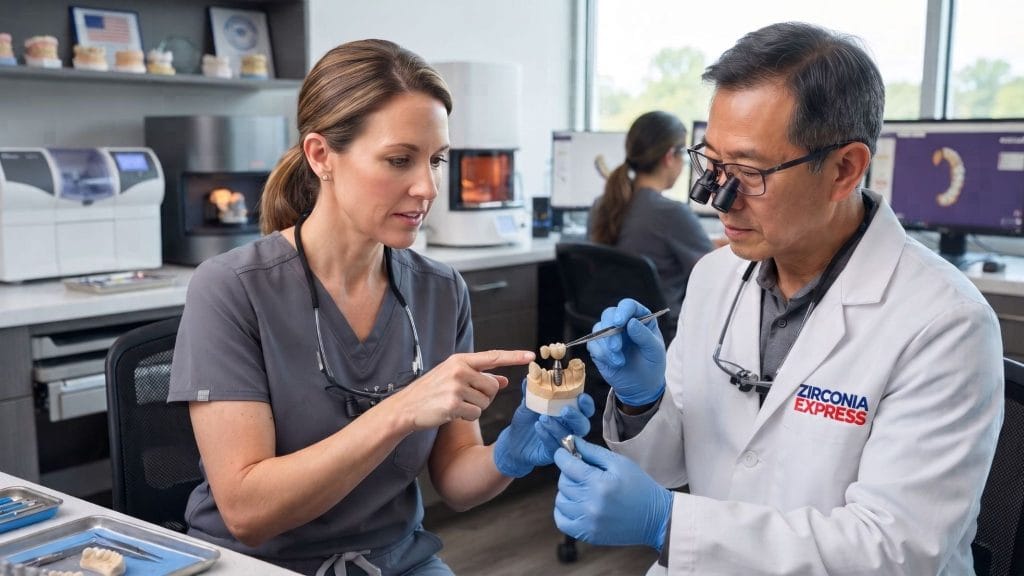
Choosing the right material is only half the equation the lab producing it matters just as much. Dentists who partner with Zirconia Express get access to premium zirconia crowns and bridges backed by a warranty of up to five years, giving both the practice and the patient long-term confidence in the restoration.
Every case benefits from high-strength zirconia formulated for the specific demands of the tooth position, whether that’s a posterior implant crown or an anterior esthetic restoration. Turnaround times stay consistent, which helps practices plan implant delivery appointments without unpredictable delays.
For practices moving further into digital workflows, Zirconia Express also offers digital dental cases built on an AI-driven design system. That system supports three distinct anatomical shape options, giving dentists flexibility to match restorations to individual patient anatomy while maintaining the precision that digital design allows.
This combination of consistent material quality, dependable turnaround, and modern digital tools is why practices across the country return to Zirconia Express case after case. If your practice is planning implant restorations and wants a lab partner that treats precision as standard rather than optional, reaching out to Zirconia Express is a straightforward next step.
Conclusion
A BruxZir implant crown earns its place in posterior implant dentistry through strength, not marketing. Its monolithic construction eliminates the layering failures that plague weaker restorations, and its wear characteristics make it a dependable choice for molars that face heavy daily loads.
Matching the right zirconia formulation to the right tooth position full strength for posterior function, higher translucency for anterior esthetics is what separates a restoration that lasts from one that comes back for a remake. Working with a lab that understands this distinction and verifies every case digitally before milling gives dentists one less variable to worry about.
FAQ’s
Is a BruxZir implant crown stronger than a porcelain-fused-to-zirconia crown?
Yes. Because a BruxZir implant crown is milled from a single solid block, it has no porcelain layer to chip or delaminate, giving it significantly higher fracture resistance for posterior use.
Can a BruxZir zirconia implant crown be used for front teeth?
It can, but dentists typically reserve full-strength BruxZir for molars and premolars where strength matters most, choosing a more translucent zirconia for visible anterior teeth where esthetics take priority.
How long does a monolithic zirconia crown typically last on an implant?
With proper occlusal design and maintenance, a monolithic zirconia crown on an implant commonly lasts well over a decade, and many practices report even longer service life with routine care.
Does a BruxZir solid zirconia crown wear down opposing natural teeth?
Properly polished zirconia is generally kind to opposing dentition. Rough or unpolished zirconia surfaces can accelerate wear, which is why finishing technique matters as much as material selection.
What’s the difference between BruxZir full strength zirconia and standard zirconia crowns?
BruxZir full strength zirconia is formulated for maximum fracture resistance in high-load posterior cases, while standard or high-translucency zirconia trades some strength for better light transmission in visible anterior restorations.