
Best Multilayer Translucent Zirconia Explained: 2026 Guide
Dentists switch to multilayer translucent zirconia for one simple reason: it lets them match natural enamel without giving up strength. This material blends layered shading with high light transmission, so a single crown can mimic the gradient of a real tooth, from a slightly opaque cervical zone to a bright, translucent incisal edge. For clinicians who once had to choose between strong monolithic zirconia and pretty but fragile layered porcelain, this shift changed the conversation entirely.
Choosing the right zirconia for a restoration isn’t just a lab decision anymore; it’s a conversation dentists have with patients who now recognize the difference between a crown that looks artificial and one that blends seamlessly with their smile. As more practices move toward fully digital workflows, understanding the material science behind modern zirconia has become just as important as understanding the clinical technique itself.
This guide breaks down what this material actually is, how it differs from older zirconia generations, when it’s the right clinical choice, and what to look for in a dental laboratory partner.
What Is Multilayer Translucent Zirconia?
Multilayer translucent zirconia is a type of zirconia dental material manufactured in graduated layers within a single milling disc. Each layer carries a different shade and translucency level, moving from a more opaque, dentin-like base to a lighter, more translucent enamel-like layer at the top.
Instead of a technician manually staining a monolithic block to fake this effect, the gradient is built into the disc itself during manufacturing. When a crown is milled from this disc, it naturally inherits the shade transition, which is why the results look closer to a real tooth right out of the sintering oven.
High translucent zirconia discs typically reach light transmission values between 45 and 50 percent, compared to roughly 25 to 30 percent for traditional 3Y zirconia. That difference is what separates a crown that looks chalky under office lighting from one that blends in.
How Does Multilayer Translucent Zirconia Differ From Traditional Zirconia?
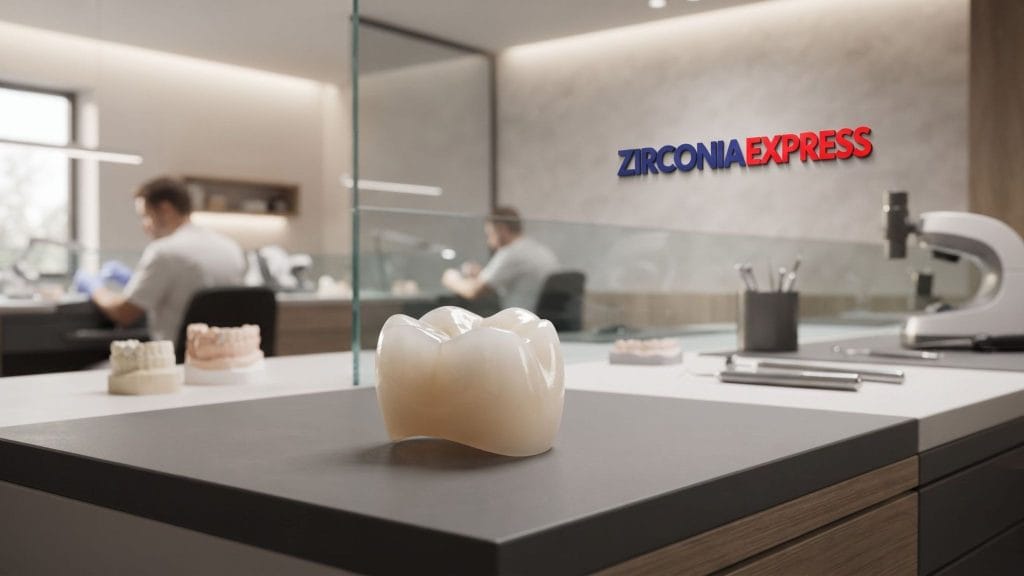
Conventional monolithic zirconia (commonly designated 3Y-TZP) was engineered with durability as its primary goal. It offered flexural strength above 1,000 MPa but had limited translucency, which made it look opaque, especially in the anterior region.
Multilayer materials solve the aesthetic gap without sacrificing much strength. Here is how the two compare on the properties that matter most in daily practice:
- Strength: Traditional zirconia often exceeds 1,000 MPa; multilayer translucent zirconia typically ranges from 600 to 850 MPa depending on the yttria content used in each layer.
- Translucency: Multilayer discs blend 3Y and 5Y zirconia zones, giving a gradual shift from opaque to translucent within one crown.
- Shade matching: Traditional zirconia usually needs external staining and glazing for a natural look; multilayer discs are pre-shaded through the block.
- Chipping risk: Because the layers are milled as one solid piece rather than veneered, multilayer zirconia avoids the porcelain fracture issues common with layered PFM or zirconia crowns.
- Best use case: Traditional zirconia suits posterior molars under heavy occlusal load; multilayer translucent zirconia suits premolars, anterior teeth, and cases where aesthetics carry real weight.
Why Is Translucent Zirconia Crown Material Gaining Popularity?
Patients are asking for restorations that look like their own teeth, not like dental work. A translucent zirconia crown answers that demand while still holding up to normal chewing forces, which is a combination older materials struggled to offer at the same time.
There’s also a workflow argument. Multilayer discs cut down chairside adjustment time because the shade gradient is already built in. A lab technician doesn’t need to hand layer porcelain or apply multiple stain cycles to get a lifelike result, which shortens turnaround without cutting corners on appearance.
Material science has caught up too. Manufacturers now produce discs with five, seven, or even more graduated zones, giving labs finer control over how a crown transitions from gingival margin to incisal edge.
When Should Dentists Choose Multilayer Zirconia Dental Crowns?
Multilayer zirconia crowns are ideally suited to situations demanding both durability and esthetics, a combination that arises far more often in everyday practice than many dentists realize
Good candidates for this material include:
- Anterior crowns where shade blending with adjacent natural teeth is critical
- Premolar restorations visible during a wide smile
- Patients with bruxism who still need better aesthetics than traditional zirconia allows
- Implant-supported single crowns in the esthetic zone
- Cases converting from PFM to a metal-free option without losing strength
For full-arch restorations and molars subjected to significant occlusal forces, clinicians may still need to select a zirconia with greater strength and reduced translucency or adopt a hybrid strategy that positions more durable material in the posterior region while reserving highly translucent material for the anterior teeth.
High-Translucent Zirconia vs. Layered Porcelain: Which Comes Out on Top?
This comparison comes up constantly in treatment planning discussions, and the honest answer depends on the case.
High translucent zirconia offers a monolithic structure, meaning no porcelain veneer layer can chip or delaminate over time. It’s milled, stained if needed, and sintered as one piece, which removes an entire category of long-term failure.
Layered porcelain, including porcelain fused to zirconia, can achieve slightly more lifelike optical depth in the hands of a highly skilled ceramist. But it comes with a real tradeoff: porcelain chipping remains one of the most common reasons patients return for repairs.
For most general and cosmetic cases, multilayer translucent zirconia gives dentists 90 percent of the aesthetic result with a fraction of the mechanical risk. That tradeoff is why adoption has grown so quickly across both general practices and specialty prosthodontic offices.
How Is Multilayer Translucent Zirconia Manufactured?
Understanding the manufacturing process helps explain why quality varies so much between labs and material brands.
- Zirconia powder is blended with yttria stabilizers at different concentrations for each disc layer.
- The layers are pressed together into a single pre-sintered blank, called a green state disc.
- The disc is milled using CAD/CAM technology based on the digital scan or impression of the prepared tooth.
- The milled restoration is sintered at high temperature, often near 1,450 degrees Celsius, which shrinks and hardens it into its final form.
- Technicians apply minimal surface characterization, then glaze and polish the crown for delivery.
This process depends heavily on precise digital design. A lab using an AI-driven design system, as the one Zirconia Express runs on its digital dental cases, can map anatomical contours and shade transitions more consistently than manual design alone, which reduces remakes and chairside adjustments.
What Should Dentists Look for in a Multilayer Zirconia Dental Lab?

Not every lab producing multilayer zirconia dental crowns delivers the same fit, shade accuracy, or turnaround time. A few questions are worth asking before choosing a lab partner:
- Does the lab disclose which disc brand and yttria formulation it uses?
- What guarantee covers the crown if it fractures or comes loose?
- How consistent is turnaround time during high-volume periods?
- Does the lab support full digital workflows, including intraoral scan files?
- Can the lab match complex shade cases, not just standard A1 through D4 ranges?
Labs based in the United States often provide faster communication and turnaround for domestic dental practices compared to overseas manufacturing, which matters when a case needs a quick remake or shade adjustment.
Partnering With a Lab That Gets Multilayer Zirconia Right
Material quality only tells half the story. The remaining half depends on the laboratory fabricating the restoration, and this is often where practices see the most noticeable variation in everyday outcomes.
Zirconia Express is a B2B dental laboratory built specifically for dentists, dental clinics, prosthodontists, implant dentists, and other labs that need dependable zirconia work at scale. Every zirconia crown and bridge is backed by up to a 5-year warranty, giving practices confidence that fits and shades will hold up over time, not just at delivery.
The lab’s digital dental cases run on an AI-driven design system with three anatomical shape options, which helps technicians produce natural, patient-specific anatomy rather than generic templates. That precision matters most in multilayer translucent zirconia cases, where shade transition and contour both need to land correctly on the first try.
Practices that work with Zirconia Express also gain a partner built around consistent quality and reliable turnaround, which supports the fast pace of modern digital dentistry rather than slowing it down. For practices ready to see what a dependable zirconia partner can do for their case acceptance and remake rates, reaching out to Zirconia Express is a straightforward next step.
Conclusion
Multilayer translucent zirconia has closed the long-standing gap between strength and aesthetics in restorative dentistry, giving clinicians a material that withstands real-world chewing forces while still blending naturally with surrounding teeth. Choosing the right case type, whether anterior, premolar, or implant-supported, is what determines whether this material performs the way manufacturers promise.
The other deciding factor is the lab behind the crown. A translucent zirconia crown is only as good as the digital design, milling precision, and shade accuracy that go into producing it, which is why the lab partnership matters just as much as the material specification sheet.
FAQ’s
What is multilayer translucent zirconia used for?
It’s used for dental crowns and bridges where both strength and natural tooth-like appearance are required, including anterior teeth, premolars, and implant-supported restorations.
Is multilayer translucent zirconia as strong as traditional zirconia?
It’s slightly less strong than traditional 3Y zirconia, typically ranging from 600 to 850 MPa versus over 1,000 MPa, but it remains strong enough for most crown and bridge applications outside of heavy-load molars.
How long does a multilayer translucent zirconia crown last?
With proper care and fit, these crowns commonly last 10 to 15 years or longer, and many labs, including Zirconia Express, back their zirconia restorations with warranties of up to 5 years.
What is the difference between 3Y and 5Y zirconia?
3Y zirconia contains 3 percent yttria and offers higher strength with lower translucency, while 5Y zirconia contains around 5 percent yttria, offering higher translucency but somewhat lower flexural strength.
How is a translucent zirconia crown different from a PFM crown?
A translucent zirconia crown is milled as a single solid piece with no porcelain veneer layer, which removes the chipping risk associated with porcelain-fused-to-metal crowns.