
Dental Crown Categories: Complete Guide to Types & Materials
Choosing the right restoration starts with understanding the dental crown categories available today. Materials have evolved fast over the last decade, and what worked as a default choice ten years ago may no longer be the best option for every patient. This guide breaks down the major crown options available, their strengths, and where each one fits best.
For most clinicians, the challenge isn’t a lack of information; it’s too much of it scattered across brochures and conflicting recommendations. A clear, side-by-side comparison puts the decision back in clinical terms and saves time at the chair. It also helps avoid the guesswork that often leads to remakes and frustrated patients.
Dental teams need more than a materials list. They need to know how strength, aesthetics, and cost trade off against each other, and how that decision plays out chairside and in the lab. That’s the focus here: practical, usable information for clinicians who want to match the right crown to the right case.
What Are Dental Crown Categories?
Dental crown categories refer to the broad groupings of restorations based on the material used to fabricate them. Each category has a distinct composition, which determines its strength, translucency, biocompatibility, and ideal clinical use.
The main categories include:
- Zirconia crowns
- Porcelain-fused-to-metal (PFM) crowns
- All-ceramic (porcelain) crowns
- Metal crowns (gold and base-metal alloys)
- Resin and composite crowns
Understanding these categories helps dentists communicate treatment options clearly, set realistic expectations, and select materials that hold up under real-world occlusal forces.
How Do Zirconia Crowns Compare to Other Materials?
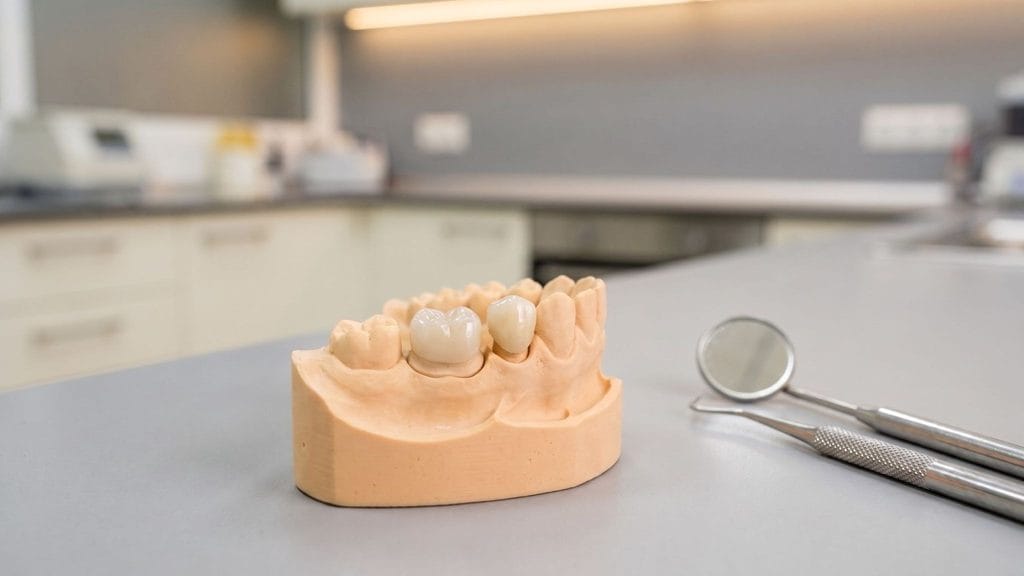
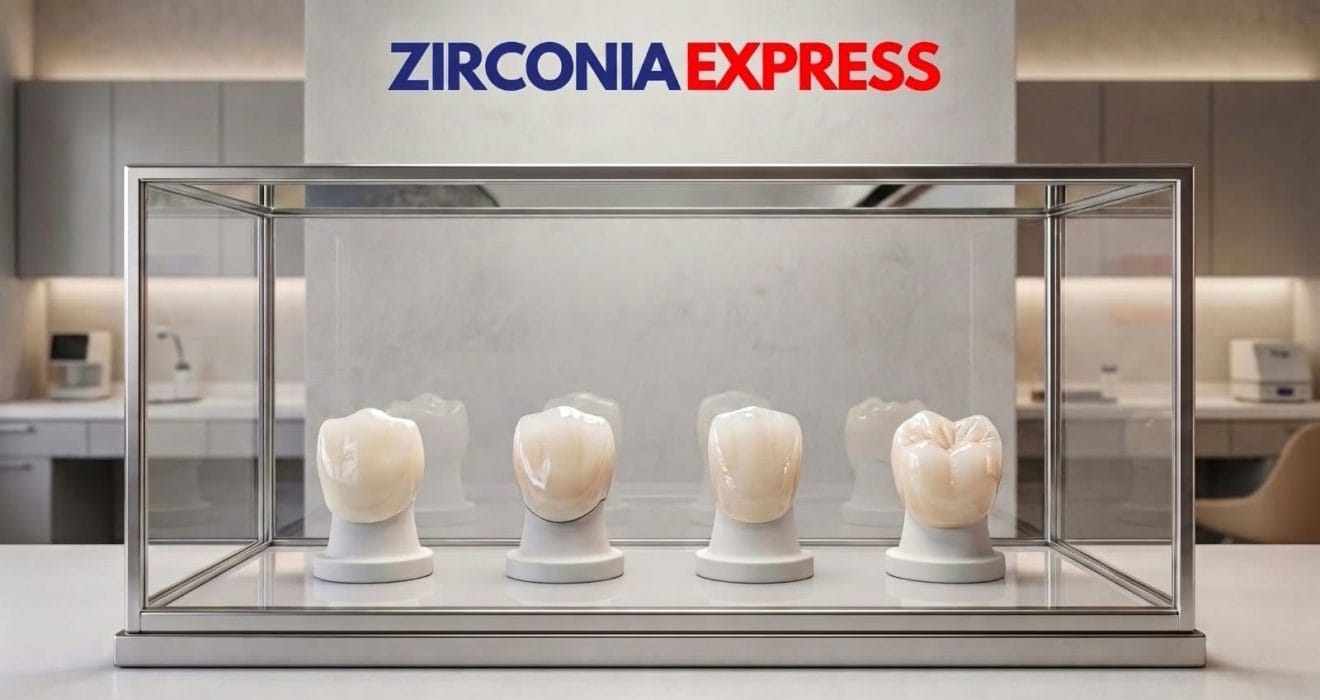
Zirconia has become the leading choice in modern restorative dentistry, and for good reason. It combines strength close to metal with an appearance close to natural enamel, which is a combination older materials struggled to deliver.
There are several zirconia dental crown types, each engineered for a different balance of strength and translucency:
- High-translucency zirconia: best for anterior teeth where aesthetics matter most.
- Monolithic zirconia: solid, single-material crowns known for exceptional fracture resistance, ideal for posterior teeth and heavy bite forces.
- Layered zirconia: a zirconia core with porcelain layering for a more lifelike, nuanced shade match.
- Multi-layered (gradient) zirconia: blends multiple shades and translucency levels within one disc, reducing the need for manual layering.
Flexural strength for zirconia typically ranges from 800 to 1,400 MPa depending on the formulation, compared to roughly 100 to 150 MPa for feldspathic porcelain. That strength margin is why zirconia has largely replaced PFM as the default posterior crown material in many practices.
What Are the Main Dental Crown Applications?
Dental crown applications extend well beyond covering a single damaged tooth. Clinicians select crown type based on the specific clinical scenario, not just tooth location.
Common applications include:
- Restoring a tooth after root canal treatment, where structural integrity is compromised, and a full-coverage restoration prevents fracture.
- Supporting a dental bridge, where crowns on abutment teeth anchor the pontic.
- Covering a dental implant, restoring function and appearance on top of an osseointegrated fixture.
- Protecting a cracked or fractured tooth from further damage under normal chewing forces.
- Improving the appearance of discolored or misshapen teeth as part of a cosmetic treatment plan.
- Reinforcing a large filling when there isn’t enough natural tooth structure left to support it.
Matching the application to the material category is where clinical outcomes are won or lost. A crown chosen purely on cost, without regard for occlusal load or aesthetic zone, tends to fail earlier or requires remakes.
Which Dental Crown Material Is Strongest?
Zirconia holds the strength advantage among the widely used dental crown categories today. Its flexural strength and fracture toughness outperform all-ceramic and PFM alternatives in posterior applications where bite forces are highest.
That said, “strongest” isn’t always “best” for every case. Here’s a quick way to think about it:
- Molars and high-stress areas: monolithic zirconia is generally the safer long-term choice.
- Front teeth and visible smile zones: layered or high-translucency zirconia balances strength with a more natural light reflection.
- Patients with bruxism: full-contour monolithic zirconia resists chipping better than layered porcelain.
- Budget-sensitive cases needing metal strength: PFM or gold alloy crowns remain viable, though aesthetics are more limited.
When Should a Dentist Choose PFM Crowns Instead?
PFM crowns still have a place in modern practice, particularly where a metal substructure is needed to support a long-span bridge or where zirconia isn’t compatible with the existing bite registration. The metal core provides rigidity, while the porcelain layer offers a tooth-like appearance.
The trade-off is a visible metal margin over time as gums recede, along with slightly higher risk of porcelain chipping compared to monolithic zirconia. For patients prioritizing long-term aesthetics with minimal maintenance, zirconia is typically the stronger recommendation.
How Does Digital Workflow Affect Crown Material Selection?
Digital dentistry has changed how labs design and mill crowns, and it’s shifted material preferences along the way. Intraoral scanning and CAD/CAM milling favor zirconia because it mills predictably and holds precise margins, something older pressed-ceramic techniques couldn’t guarantee at scale.
AI-assisted design systems now help labs generate anatomically accurate crown proposals faster, reducing the back-and-forth between clinic and lab. This matters for dental crown applications where turnaround time affects patient scheduling, especially in same-day or short-timeline restorative cases.
Why Do Turnaround Time and Warranty Matter When Selecting a Lab Partner?
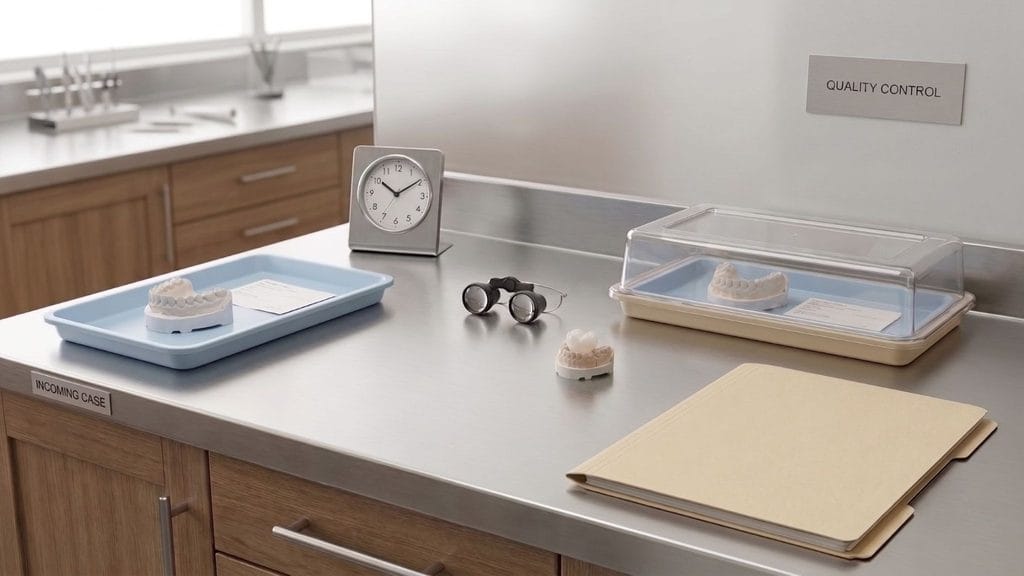
Material choice is only half the equation. The lab producing the crown affects fit accuracy, longevity, and how much chair time a dentist spends on adjustments or remakes.
A few factors worth evaluating in a lab partner:
- Warranty coverage on finished restorations, which signals confidence in material and fabrication quality.
- Digital workflow compatibility, so scans transfer cleanly without manual rework.
- Consistency across cases, since shade and fit variability create chairside delays.
- Turnaround speed, particularly for practices running high case volumes.
These factors are exactly where working with an established zirconia specialist pays off in day-to-day practice efficiency.
How Zirconia Express Supports Modern Restorative Dentistry
Dentists evaluating their restoration options for their practice often look for a lab partner that removes guesswork from material selection. Zirconia Express, a B2B dental laboratory based in North Carolina, works with dentists, prosthodontists, implant specialists, and dental practices to deliver zirconia restorations built for consistency and durability.
Every zirconia crown and bridge from Zirconia Express is backed by up to a five-year warranty, giving clinicians confidence in long-term performance without added risk. The high-strength zirconia formulation is engineered for natural aesthetics, so anterior and posterior cases both get a restoration that fits the patient’s bite and smile.
For practices running digital workflows, Zirconia Express offers digital dental cases powered by an AI-driven design system, with three anatomical shape options to match different patient anatomies and clinical goals. This combination of precision design and digital workflow compatibility helps practices reduce remakes and keep case timelines predictable.
Fast turnaround is built into the process, so practices aren’t left waiting on cases that hold up scheduling. If you’re looking for a lab partner that combines premium materials, reliable warranty support, and modern digital capability, it’s worth reaching out to Zirconia Express to discuss your next case.
Conclusion
Selecting from the available dental crown categories isn’t just a materials decision; it’s a clinical strategy that affects fit, longevity, and patient satisfaction. Zirconia, PFM, all-ceramic, and metal crowns each serve distinct roles depending on tooth location, occlusal load, and the case’s aesthetic demands.
As digital workflows continue to reshape restorative dentistry, the various zirconia dental crown types are increasingly becoming the practical default for practices that want strength, predictability, and a natural appearance in one material. Choosing a lab partner that understands these trade-offs and can execute them consistently makes that decision easier for every case that follows.
FAQ’s
What is the most durable type of dental crown?
Monolithic zirconia is generally the most durable dental crown type available today, with flexural strength reaching up to 1,400 MPa. It resists chipping and fracture better than porcelain-based alternatives, making it well suited for posterior teeth and patients with strong bite forces.
How long do zirconia crowns typically last?
Zirconia crowns commonly last 10 to 15 years or longer with proper oral hygiene and regular dental checkups. Longevity depends on bite force, oral care habits, and the quality of the fabrication and fit.
What is the difference between monolithic and layered zirconia crowns?
Monolithic zirconia crowns are milled from a single solid block, offering maximum strength and minimal chipping risk. Layered zirconia crowns use a zirconia core with a porcelain overlay for enhanced aesthetics, though this adds a small risk of porcelain chipping over time.
Are zirconia crowns better than porcelain-fused-to-metal crowns?
Zirconia crowns generally outperform PFM crowns in strength, biocompatibility, and long-term aesthetics, since PFM crowns can show a visible metal margin as gums recede. PFM remains a reasonable option for certain long-span bridge cases requiring extra structural rigidity.
Which dental crown type looks most natural?
High-translucency and layered zirconia crowns tend to look the most natural, particularly in the front teeth, because they mimic the light-reflecting properties of natural enamel. Multi-layered zirconia discs with gradient shading further improve the blend between the crown and surrounding teeth.
How do dental labs determine which crown material to recommend?
Dental labs and clinicians typically base material recommendations on tooth location, occlusal forces, patient aesthetic goals, and any relevant medical or allergy considerations. Digital scan data also plays a role, since some materials mill more predictably from intraoral scans than others.