

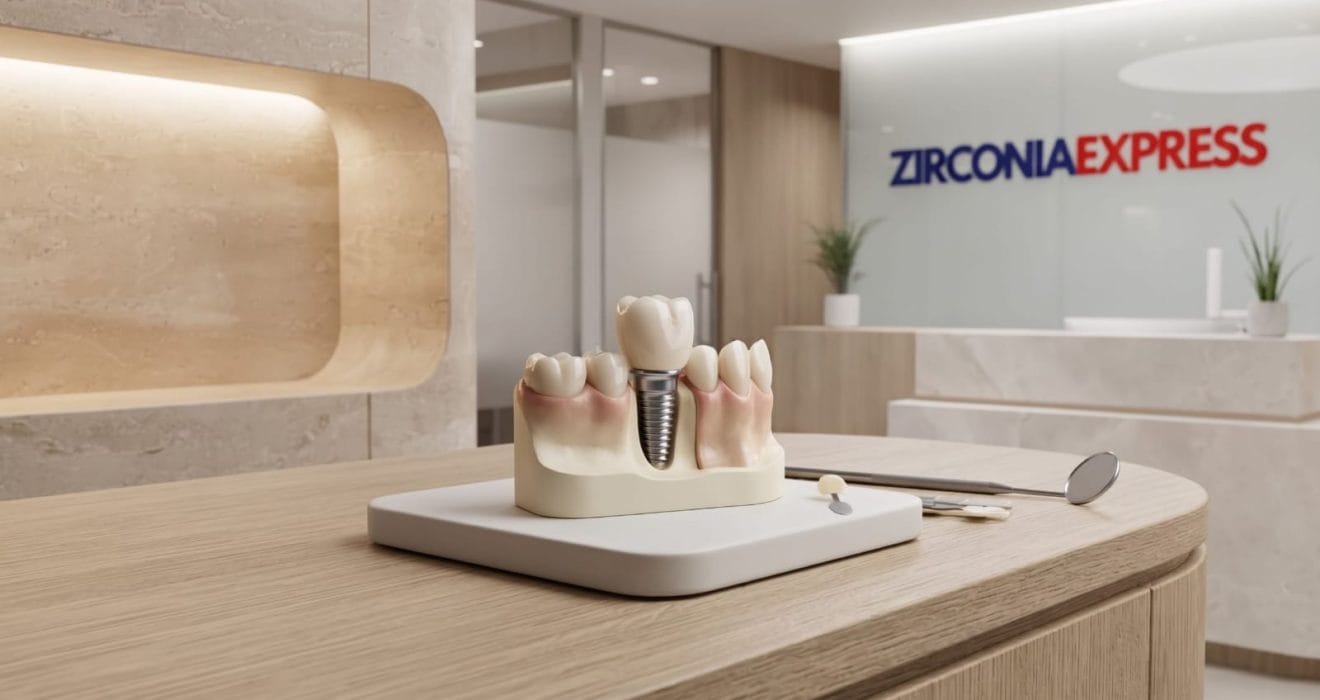
Crown for Dental Implants: Types & Key Benefits
A crown for dental implants is the visible, tooth-shaped restoration that attaches to an implant post, replacing a missing tooth above the gumline. It’s the final, functional piece of the implant puzzle, the part patients actually see and use every day. Getting the type and material right affects how the restoration looks, how long it lasts, and how well it performs under bite force.
Patients often assume the implant itself is the hardest part of treatment, but the crown plays just as big a role in the outcome. The wrong material or a poorly fitted crown can lead to discomfort, uneven wear, or a restoration that looks out of place next to natural teeth. Getting this stage right is what turns a surgically successful implant into a restoration the patient is actually happy with.
This guide breaks down the types of dental implant crown options, the materials used to make them, and the practical benefits each choice offers. Whether you’re a general dentist explaining options to a patient or a lab technician selecting materials for a case, this covers what matters most.
What Is a Crown for Dental Implants?
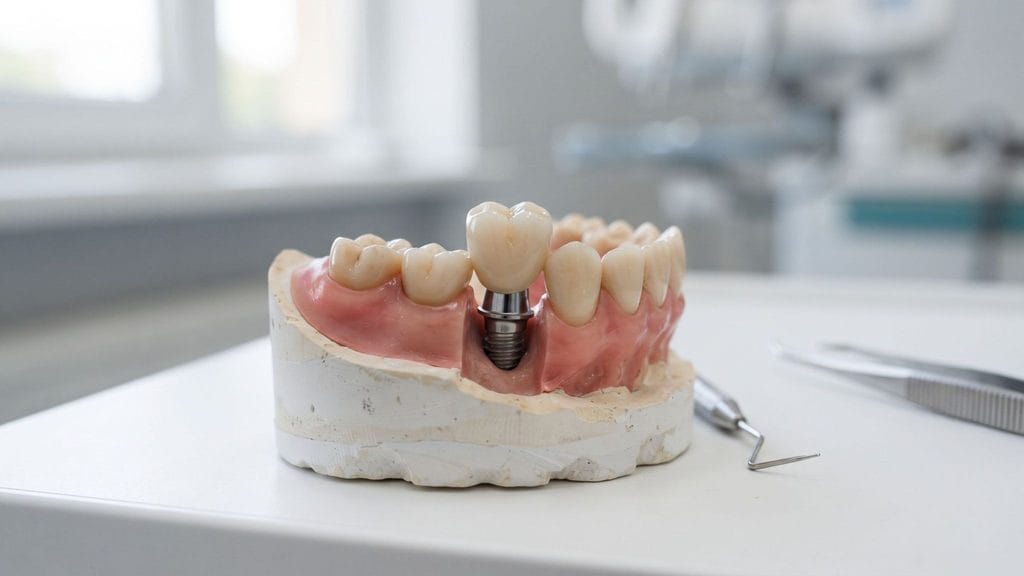
A crown for dental implants is a custom-made prosthetic tooth designed to sit atop a dental implant, connected either directly to the implant or to an abutment. Unlike a traditional crown, which caps a natural tooth, this restoration relies entirely on the implant fixture anchored in the jawbone for support.
The crown handles chewing forces, restores appearance, and prevents shifting of neighboring teeth. It’s manufactured to match the shape, color, and contour of the patient’s natural dentition, so the result blends in rather than standing out.
How Does a Dental Implant Crown Attach to the Implant?
There are two primary attachment methods, and the choice affects both maintenance and aesthetics.
- Screw-retained crowns: A screw passes through the crown into the implant or abutment, holding it in place. This allows the dentist to remove the crown later for adjustments or repairs without disturbing the implant.
- Cement-retained crowns: The crown is cemented onto an abutment, much like a traditional crown on a natural tooth. This method often produces a slightly better aesthetic result because there’s no visible screw access hole.
Neither approach is universally better. Screw-retained restorations offer easier retrievability, while cement-retained restorations can simplify occlusal adjustments and give a cleaner surface.
What Are the Main Types of Dental Implant Crowns?
Dental implant crown types vary based on how they’re designed, attached, and how many teeth they replace.
Single-unit crowns replace one missing tooth and attach to a single implant. They’re the most common type, used for isolated gaps.
Implant-supported bridges replace multiple adjacent missing teeth using two or more implants as anchor points, with pontics (false teeth) spanning the gap between them.
Implant-supported overdentures use several implants to stabilize a full removable or fixed denture, ideal for patients missing most or all of their teeth in an arch.
Each type serves a distinct clinical situation, so case selection depends on how many teeth are missing, bone density, and the patient’s long-term goals.
Which Dental Implant Crown Materials Perform Best?
Dental implant crown materials determine strength, appearance, and how the restoration wears against opposing teeth. Here’s how the main options compare.
Zirconia is a high-strength ceramic known for durability and a natural, tooth-like translucency. It resists chipping better than porcelain-fused-to-metal and is increasingly the material of choice for both anterior and posterior implant crowns because it balances strength with aesthetics.
Porcelain-fused-to-metal (PFM) combines a metal substructure with a porcelain outer layer. It’s strong and time-tested, though the metal base can sometimes create a visible gray line near the gum over time.
Full-porcelain crowns offer excellent light-transmitting properties for front-tooth aesthetics but are generally less fracture-resistant than zirconia, making them better suited to lower-bite-force areas.
Gold and metal alloy crowns remain in use for some posterior cases due to exceptional durability, though they’re less common now given the strong aesthetic and mechanical performance of modern zirconia.
For labs producing high volumes of restorations, consistent material quality matters as much as the material choice itself. Zirconia Express, a dental laboratory based in North Carolina, fabricates zirconia crowns and bridges specifically engineered for the strength and fit implant cases demand.
What Are the Benefits of a Crown for Dental Implants?
Dental implant crown benefits go beyond simply filling a gap in a patient’s smile.
- Restores full chewing function, allowing patients to eat a normal diet again
- Prevents bone loss in the jaw by transmitting bite force through the implant, similar to a natural tooth root
- Stops adjacent teeth from drifting into the space
- Preserves facial structure by maintaining bone volume in the jaw
- Matches natural tooth shade and shape for a seamless smile
- Offers long-term durability compared to removable prosthetics
- Requires no alteration of neighboring healthy teeth, unlike a traditional bridge
These benefits are why implant-supported crowns have become a standard recommendation for single-tooth replacement in modern restorative dentistry.
How Long Does a Dental Implant Crown Last?
With proper care, a zirconia or high-quality PFM implant crown typically lasts 10 to 15 years, and many last far longer. When properly osseointegrated, the implant fixture itself can function for decades.
Longevity depends on material choice, occlusal forces, oral hygiene, and whether the patient wears a night guard if they grind their teeth. Regular dental checkups allow early detection of wear or minor issues before they become larger problems.
When Should a Dentist Choose Zirconia Over PFM?

Zirconia is generally the stronger choice when esthetics and biocompatibility are top priorities, particularly for anterior restorations where a natural, translucent appearance matters. Among the various dental implant crown materials, it also performs well in posterior regions thanks to its high flexural strength.
PFM may still be selected in cases with limited interocclusal space or when a dentist has an established workflow with metal substructures. That said, advances in zirconia milling and layering have narrowed the gap, and many practices have shifted toward zirconia as their default for both anterior and posterior implant crowns.
Partnering With a Trusted Lab for Implant Crown Cases
Choosing the right material and design is only part of the process. Consistency in fabrication, fit, and turnaround time is what actually determines how smoothly a case goes from impression to seat.
Zirconia Express supports dentists, prosthodontists, and dental laboratories with premium zirconia crowns and bridges backed by up to a 5-year warranty, giving practices confidence in the long-term performance of every case they send out. Their digital dental cases are built on an AI-driven design system offering three distinct anatomical shape options, so clinicians can match restorations to a patient’s natural anatomy with precision rather than guesswork.
For practices moving toward a fully digital workflow, this kind of consistency matters. Reliable turnaround times mean fewer scheduling delays, and predictable quality means fewer remakes. Dentists working with Zirconia Express get a lab partner built around modern digital dentistry, from scan to final restoration, rather than a one-size-fits-all production line.
If you’re looking for a lab that treats each case with the same precision you bring to your own practice, reach out to Zirconia Express to discuss your next implant restoration case.
Conclusion
Choosing the right crown for dental implants comes down to matching material and design to the clinical situation, whether that’s a single missing tooth, a multi-unit bridge, or a full-arch restoration. Zirconia has become the leading choice for many cases because it combines strength with a natural appearance that patients notice immediately.
Selecting the right dental implant crown types and materials, paired with a dependable lab partner, is what turns a good treatment plan into a long-lasting result for the patient. Getting these fundamentals right up front saves time, reduces remakes, and builds patient trust in the restoration’s durability.
FAQ’s
How does a dental crown differ from a dental implant crown?
A regular crown caps a natural tooth, while a dental implant crown attaches to a titanium or zirconia implant post that’s surgically placed in the jawbone. The implant crown replaces the entire tooth, root included.
Is zirconia better than porcelain for implant crowns?
Zirconia generally offers greater strength and chip resistance than full porcelain, making it a common choice for both front and back teeth. Porcelain can offer slightly better translucency for very visible front teeth in some cases.
How much does a dental crown for implants cost?
Costs vary by location, material, and case complexity, but implant crowns are generally priced in the mid range, neither the cheapest nor the most expensive dental restoration option, separate from the cost of the implant surgery itself.
Can a dental implant crown be replaced if it breaks?
Yes. Screw-retained crowns are especially easy to remove and replace without disturbing the implant. Cement-retained crowns can also be replaced, though removal may require more care.
How soon after implant placement can a crown be attached?
Crown placement typically happens 3 to 6 months after implant surgery, once osseointegration is confirmed. Some cases qualify for immediate loading, where a crown is placed sooner, depending on bone quality and implant stability.