

Best Full Mouth Zirconia Crowns for Durability and Aesthetics
Table of Contents
Rewind fifteen years, and zirconia was the material dentists hid in the back of the mouth – strong, sure, but about as lifelike as a bathroom tile. Fast forward to today, and it’s the backbone of modern full arch dentistry.
Full mouth zirconia crowns have become the restoration of choice for complete smile reconstructions, and the reasons go far beyond trends. Patients want two things from a new smile: it has to look real, and it has to last. Zirconia is the rare material that checks both boxes without forcing a compromise.
In this guide, we’ll walk through the science, the clinical numbers, prep protocols, and what separates a great full arch outcome from an expensive remake.
Full Mouth Zirconia Crowns Explained
A full mouth zirconia crowns restores an entire arch – or both arches – using crowns milled from zirconium dioxide, one of the toughest ceramics used anywhere in medicine. Common candidates include:
- Patients with generalized wear from grinding, acid erosion, or decades of attrition
- Mouths full of aging, failing restorations that need a unified reset
- Implant patients receiving fixed full arch prosthetics
- Cases requiring a new vertical dimension due to bite collapse
- Anyone seeking a comprehensive cosmetic overhaul with long-term function
Unlike the PFM era, there’s no metal substructure hiding underneath. That means no dark gingival margins, no opaque “denture look,” and no porcelain popping off a metal coping a few years down the road.
How the Materials Stack Up
| Restoration Type | Strength (MPa) | Aesthetic Grade | Fracture/Chip Risk | Expected Service Life |
| Monolithic zirconia | 900–1,200 | B+ to A− | Minimal | 10–15+ yrs |
| Layered zirconia | 600–1,000 (core) | A+ | Low–moderate | 10–15 yrs |
| Lithium disilicate | 360–500 | A+ | Moderate | 8–12 yrs |
| PFM | 80–100 (veneer layer) | B | Moderate–high | 7–10 yrs |
| Acrylic hybrid | Under 100 | C+ | High | 3–7 yrs |
When you’re betting an entire arch – and a patient’s trust – on one material decision, those strength figures stop being abstract and start being the whole ballgame.
The Numbers Behind Zirconia’s Rise
Clinical evidence, not marketing, explains why zirconia took over full arch work:
- Survival data: Published studies consistently place 5-year survival of monolithic zirconia crowns in the mid-90s to 99% range – top-tier among all-ceramic options.
- Raw strength: At up to 1,200 MPa flexural strength, full-strength zirconia outmuscles lithium disilicate by roughly 3x and conventional porcelain by more than 10x.
- Enamel friendliness: Here’s the surprise finding – well-polished zirconia wears opposing enamel less than glazed porcelain does. Multiple lab studies have confirmed it.
- Tissue response: Zirconia is bioinert and attracts less plaque than many competing materials – no small thing when every tooth in the arch is restored.
This is also why the full mouth zirconia crowns have overtaken the acrylic hybrid in so many implant practices. Acrylic prosthetics tend to stain, absorb odors, and shed denture teeth, often demanding a rebuild within five to seven years. A monolithic zirconia bridge on four to six implants sidesteps that entire maintenance cycle – and patients immediately notice how solid it feels compared to acrylic.
Monolithic vs. Layered: Picking Your Build
Every dentist planning a complete arch eventually faces this fork in the road. The right answer depends on the patient, not the brochure.
Monolithic Zirconia
One solid milled block, no veneering porcelain. Today’s multilayer pucks include built-in gradients of shade and translucency, so the old “too white, too flat” criticism barely applies anymore.
Reach for monolithic when you have:
- A confirmed or suspected bruxer
- Posterior-heavy treatment plans
- Tight occlusal clearance (it survives at 0.8–1.0 mm thickness)
- A patient who values bulletproof over breathtaking
Layered Zirconia
A zirconia core with hand-applied feldspathic porcelain on visible surfaces. For cases demanding true vitality – translucent incisal halos, internal effects, lifelike surface texture, layered zirconia crowns full mouth restorations remain the aesthetic ceiling. A talented ceramist builds in optical character that no milled puck can fully imitate.
The Zone Strategy (Our Recommendation)
| Arch Zone | Material Spec | Why |
| Anteriors | Layered or micro-layered | The smile zone deserves artistry |
| Premolars | High-translucency monolithic | Smooth visual transition |
| Molars | Full-strength 3Y monolithic | Built for the crush zone |
Front teeth that photograph beautifully, back teeth that shrug off a thousand Newtons. Best of both worlds.
Tooth Preparation for Zirconia Crowns: Getting the Foundation Right
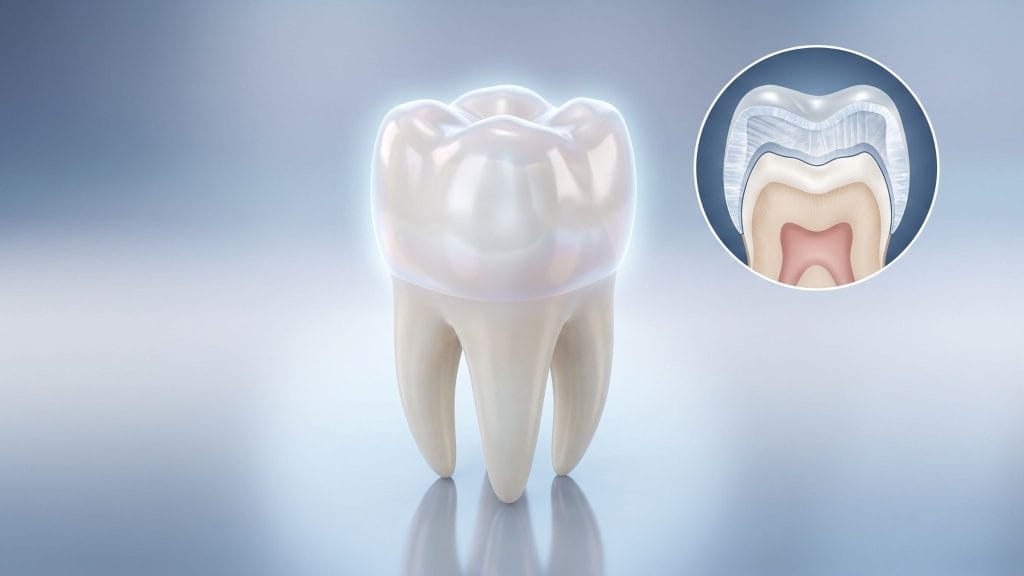
Great material can’t rescue a flawed prep. The good news: tooth preparation for zirconia crowns is more forgiving than glass-ceramic preps – but full arch cases magnify every shortcut by 28 units.
Target Specifications
| Parameter | Monolithic | Layered |
| Occlusal clearance | 1.0–1.5 mm | 1.5–2.0 mm |
| Axial reduction | 0.8–1.2 mm | 1.2–1.5 mm |
| Margin | Chamfer, 0.5 mm minimum | Rounded shoulder |
| Total convergence | 4–8° | 4–8° |
| Line angles | Rounded, no exceptions | Rounded, no exceptions |
Three Prep Mistakes That Cause Remakes
- Crisp internal angles. Milling burs can’t reproduce them, and stress concentrates exactly there under load. Soften everything.
- Stingy molar reduction. Zirconia can survive thin, but 1.5 mm gives your technician room for real anatomy and gives you adjustment headroom at delivery.
- Knife-edge margins. They scan poorly, mill worse, and leave fragile crown edges. A clean chamfer costs seconds and saves weeks.
Full arch tip: Fabricate a reduction guide from the diagnostic wax-up. When fourteen preps need to land at a new vertical dimension, freehanding is a gamble you don’t need to take.
Durable Zirconia Crowns for Molars: Built for the Crush Zone
Normal chewing puts 500–900 Newtons of force on molars. Add parafunction, and forces can blow past 1,000 N. This is zirconia’s home turf – but only if you spec it correctly.
Durable zirconia crowns for molars deserve a different recipe than anterior units:
- Pick 3Y-TZP (roughly 1,100–1,200 MPa) over the prettier 4Y/5Y blends (600–800 MPa). Posterior translucency impresses nobody; posterior fractures impress everybody – in the worst way.
- Bridge connectors: never below 9 mm² in cross-section posteriorly; push toward 12 mm² on longer spans.
- Occlusion: distribute contacts evenly, and design shallow anterior guidance to unload the posterior segments during excursions.
- Polish after every adjustment. Adjusted-but-unpolished zirconia acts like sandpaper against opposing enamel. Run the full polishing sequence – coarse to fine – every single time.
The payoff for getting this right? Studies on monolithic zirconia molar crowns report fracture rates under 1% at five years, while PFM chipping over the same period runs 8–15%. That gap is your patient’s next decade.
Full Mouth Rehabilitation with Zirconia Crowns: The Four-Phase Playbook
Ask any prosthodontist: full mouth rehabilitation with zirconia crowns succeeds or fails in the planning room, not the operatory. Here’s the sequence that consistently delivers:
Phase 1 – Diagnose & Design (Weeks 1–2)
Records, imaging, mounted models, or full digital scans. Decide the vertical dimension question early: restore as-is, or open the bite? Complete a digital smile design and wax-up, and get the patient’s sign-off before touching a bur.
Phase 2 – The Test Drive (Weeks 3–8)
Prep and provisionalize at the planned VDO. Let the patient live with the new bite, speech patterns, and smile for a month or two. Every adjustment you make becomes design data for the finals.
Phase 3 – Definitive Delivery (Weeks 8–12)
Final scans (segment full arch captures for accuracy), lab fabrication that copies the approved provisionals, then try-in, refinement, polish, and seat.
Phase 4 – Protect the Investment
A nightguard is mandatory for every full mouth case – bruxer or not. Recall at six-month intervals with occlusal checks for the first two years.
The thread running through all four phases? Replicate what the patient already approved. When your lab cross-mounts the provisional scan against the prep scan, delivery day holds zero surprises – just a more refined version of a smile the patient has already fallen in love with.
Vetting a Lab for Full Arch Zirconia Work
Zirconia quality varies wildly between labs, and full arch cases expose every weakness. Before committing 28 units to anyone, ask:
- Where does the zirconia come from? Premium, FDA-registered blanks with batch traceability – or mystery pucks?
- How disciplined is the sintering? Shortcut sintering schedules quietly sabotage final strength.
- Is the workflow truly digital? Scan acceptance, provisional cross-mounting, and pre-mill design approval should all be standard.
- What’s the warranty? A lab unwilling to guarantee its work is telling you something.
- Do they hit deadlines? Full arch treatment involves chained appointments – one late case wrecks your whole schedule.
Make Your Next Full Arch Case a Zirconia Express Case
Time to drop the neutral narrator voice – because if you’re a dentist with a full arch case on the books, we want it on our bench.
Zirconia Express is a dental lab based in North Carolina, built for practices that refuse to choose between strength and beauty.
Restorations Guaranteed for Up to 5 Years
Our zirconia crowns and bridges come backed by up to a 5-year warranty. We can offer that because we obsessively control our material sourcing, milling tolerances, and sintering protocols. For you, it means quoting full mouth treatment plans with genuine confidence – if something fails, the remake is our problem, not yours.
Send Us a Digital Case and Feel the Difference
Our digital workflow is where partnership turns into a competitive edge:
- AI-driven design systems read your scans and generate restorations with optimized contacts, contours, and occlusion – translating to dramatically less chairside adjustment
- Three shape libraries let you match each patient’s natural morphology instead of forcing one generic anatomy onto every arch
- No impression material, no shipping delays, no distortion – just faster turnarounds and tighter fits
Still sending PVS? A full arch zirconia case is the perfect time to switch. Submit your first digital case to Zirconia Express and judge the fit, speed, and predictability for yourself.
Your next full arch deserves a lab that treats it like the flagship case it is. Send it to Zirconia Express.
Conlusion
Full mouth zirconia crowns sit at the top of complete arch dentistry because the evidence put them there: strength figures north of 1,000 MPa, five-year survival approaching 99%, and modern aesthetics that finally match the engineering.
The winning formula isn’t complicated – match the zirconia formulation to each zone of the arch, respect the prep guidelines, let provisionals prove the design, protect everything with a nightguard, and team up with a lab that sweats the details as much as you do.
Patients walk in asking for a smile that looks real and lasts for decades. With full mouth rehabilitation with zirconia crowns and the right lab behind you, that’s not a sales pitch – it’s a treatment plan.
FAQ’s
How long do full mouth zirconia crowns last?
With proper care, full mouth zirconia crowns can last 10–15 years or longer. Regular checkups and a nightguard can help extend their lifespan.
Are zirconia crowns better than PFM crowns?
Zirconia crowns offer greater strength and more natural aesthetics than PFM crowns. They also eliminate the dark metal margin often seen with metal-based restorations.
Do zirconia crowns look natural?
Yes, modern zirconia provides excellent translucency and a life-like appearance. Layered zirconia can deliver even more realistic cosmetic results.
Are zirconia crowns good for teeth grinders?
Yes, zirconia is highly resistant to fracture and wear. Monolithic zirconia is often recommended for patients with bruxism.
What is tooth preparation for zirconia crowns?
The teeth are reshaped to create space for the crowns while preserving healthy structure. Accurate preparation helps ensure a precise fit and long-term success.
Do zirconia crowns require special maintenance?
No, they can be maintained with normal brushing, flossing, and routine dental visits. A nightguard may also be recommended for added protection.

1 Comment